Recording Logs with Conditions
Triggers automatically start and stop logging when the following predefined conditions are detected during monitoring.
- A specific log is detected (Log Trigger)
- A specific key is pressed (Key Trigger)
- A specific signal value meets a threshold condition (Signal Trigger)
This lets you efficiently save logs for just the periods you need.
Configure triggers in Trigger Window.
Trigger Modes
To control log recording with trigger conditions, turn on Save Log File on the main toolbar. Start and stop behavior depends on the mode.
| Trigger mode | Behavior |
|---|---|
| Free Run | Disables triggers. Logging starts and stops together with monitoring. |
| Triggered | Recording starts when a start condition is met. If no start condition is configured, recording starts together with monitoring. When a stop condition is met during recording, both recording and monitoring stop. |
| ReTriggered | Recording starts when a start condition is met. When a stop condition is met during recording, the interval ends and the application waits for the next start. Monitoring also stops when 64 recording intervals have been completed. |
A stop condition met while waiting for a start does not end monitoring or increment the interval count. ReTriggered requires a start condition. Configure a stop condition as well for repeated recording. When a start condition is met, the recording interval's start time is recorded. Communication log CSV files are output for each interval after monitoring stops. If a later interval has no log records for the target channel, a file may not be created for that interval.
Types of Recording Conditions
| Condition | Use |
|---|---|
| Signal Trigger | Evaluate signal values |
| Log Trigger | Evaluate frame ID, channel, data, and other properties |
| Key Trigger | Start and stop recording through operator key input |
When multiple condition types are enabled on the same start or stop side, any one of them can trigger the action. Turn off Log Trigger and Key Trigger on a side that should use only a signal condition.
Configuring Signal Triggers
Signal Window alerts provide notifications of condition activation/recovery and a history for review. Enabling an alert alone does not make it a log recording start or stop condition.
- Stop monitoring and add the target signal to the Set to use in Signal Catalog. Assign the channel and make that Set the Current Set.
- Set Trigger Mode in Trigger Window to Triggered or ReTriggered.
- Open Select Signal for Start Signal Trigger or Stop Signal Trigger.
- From the Current Set candidates, select a numeric bus signal with a channel assigned. For unavailable candidates such as derived signals, ASCII signals, or signals without channel assignments, check the reason shown on screen.
- Set Condition (Above/Below), Threshold, and Hys, then click OK. Comparisons use numeric values converted according to the definition. If a factor or offset is defined, enter values in physical units.
- Enable the Start Signal Trigger/Stop Signal Trigger to use. Turn on Save Log File, specify the destination, and start monitoring.

Figure 1a: Selecting the target signal in Select Signal.
Figure 1a shows an input candidate list. Select Simulated_RPM_demo in the second row. Check the signal name and Start column to distinguish it from the target speed in the first row. The actual rotational speed row has CH1-1, ID 0x310, Start 16, Length 16, and Unit rpm.
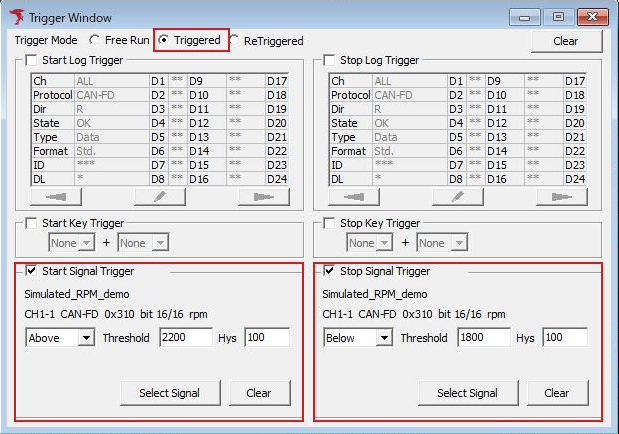
Figure 1b: Recording start and stop conditions based on actual rotational speed.
Figure 1b shows actual settings using FanDemo's Simulated_RPM_demo. The target is CH1-1, CAN FD, ID 0x310, start bit 16, signal length 16 bits, unit rpm. Triggered is selected; Start/Stop Signal Trigger are on, and Log Trigger and Key Trigger are off.
| Side | Comparison condition and recovery width |
|---|---|
| Start Signal Trigger | Above Threshold:2200 rpm Hys:100 rpm |
| Stop Signal Trigger | Below Threshold:1800 rpm Hys:100 rpm |
These are the configured thresholds. Distinguish them from the current Values readings at screenshot capture time and the boundary values in the recorded CSV. The Speed example below illustrates evaluation logic; its signal and units differ from Figure 1b.
Threshold and Hys
| Condition | Value that activates the condition while waiting | Value that rearms it after activation |
|---|---|---|
| Above | At or above Threshold | Less than Threshold minus Hys |
| Below | At or below Threshold | Greater than Threshold plus Hys |
If the first valid frame received already meets the condition, it activates immediately. Once activated, the same condition does not activate again until a value that rearms it is received. Frames with mismatched channel, ID, direction, length, or other properties, and invalid values, do not change this state.
For example, configure Speed in the sample DBC with Above, Threshold 10 km/h, and Hys 2 km/h.
| Example reception time | Speed | Evaluation |
|---|---|---|
| 0.0 s | 10 km/h | First activation |
| 0.1 s | 8 km/h | Equal to the rearm boundary, so not rearmed |
| 0.2 s | 7.5 km/h | Rearmed for the next activation |
| 0.3 s | 10 km/h | Activates again |
This table illustrates evaluation of the same condition. Actual recording behavior follows the start/stop settings and trigger mode.
The signal definition and channel at selection time are recorded in Trigger Setting. After switching Current Set or changing signal definitions or channel assignments, recheck the conditions in Select Signal.
Basic Operation
Configuring Log Triggers
1. Open Trigger Window
Select Trigger Window from the menu or toolbar.
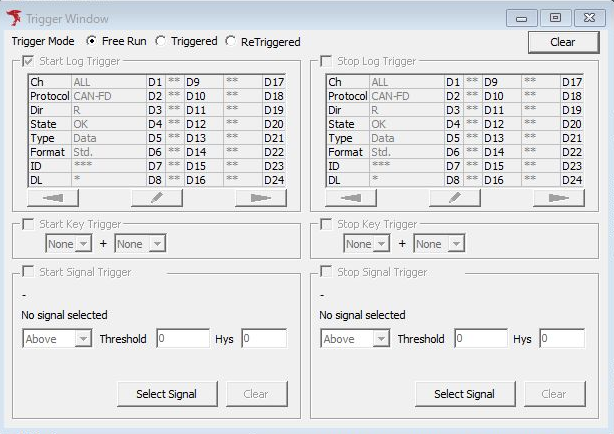
2. Enable triggers
In Trigger Mode, select the Triggered or ReTriggered radio button. This enables triggers and makes the following items configurable.
- Start Log Trigger
- Stop Log Trigger
- Start Key Trigger
- Stop Key Trigger
- Start Signal Trigger
- Stop Signal Trigger
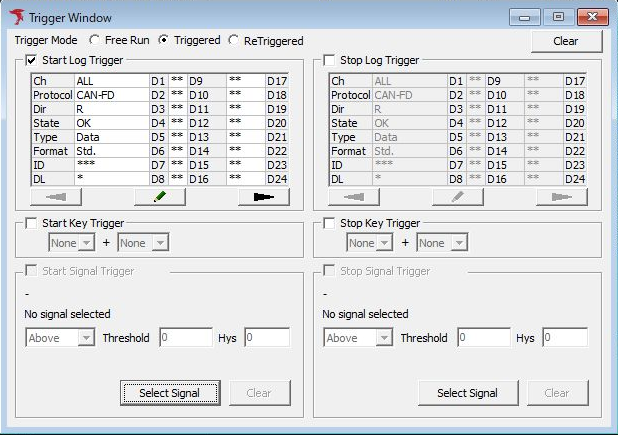
Triggered is selected in the example above.
3. Enable a start or stop Log Trigger
Check Start Log Trigger or Stop Log Trigger to enable the corresponding trigger.
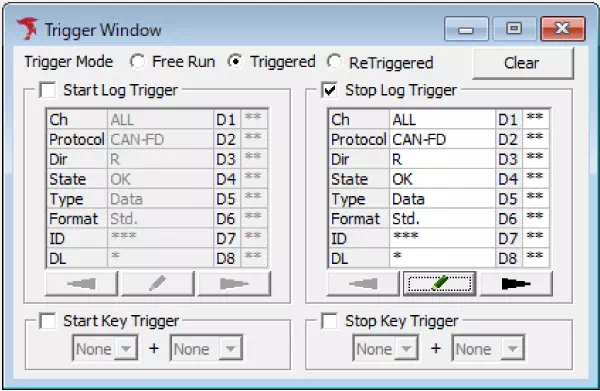
The example above enables Stop Log Trigger by checking its checkbox.
4. Open the Trigger Setting dialog
In the area enabled in step 3, click the  button, or double-click the trigger condition display area, to open the Trigger Setting dialog.
5. Set the Log Trigger conditions
In the Trigger Setting dialog, set the Log Trigger conditions, such as protocol, channel, and transmission/reception direction.
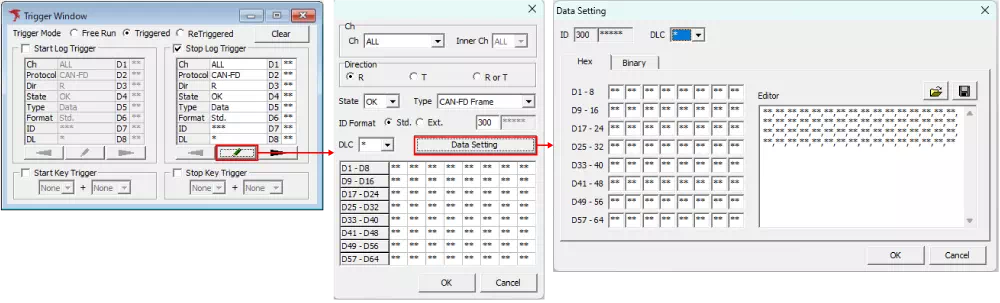
The example above uses reception of a CAN FD frame with ID 300H as the stop Log Trigger condition.
For details of the Trigger Setting dialog, see Log Trigger Setting Dialog.
6. Register the Log Trigger conditions
In the Trigger Setting dialog, click the  button.
The configured Log Trigger conditions are registered and displayed in the trigger condition area of Trigger Window.
7. Monitor
When monitoring starts, logging starts or stops as the configured trigger conditions are detected.
Configuring Key Triggers
1. Open Trigger Window
Select Trigger Window from the menu or toolbar.
2. Enable triggers
In Trigger Mode, select the Triggered or ReTriggered radio button. This enables triggers and makes the following items configurable.
- Start Log Trigger
- Stop Log Trigger
- Start Key Trigger
- Stop Key Trigger
- Start Signal Trigger
- Stop Signal Trigger
Triggered is selected in the example above.
3. Enable a start or stop Key Trigger
Check Start Key Trigger or Stop Key Trigger to enable the corresponding trigger.
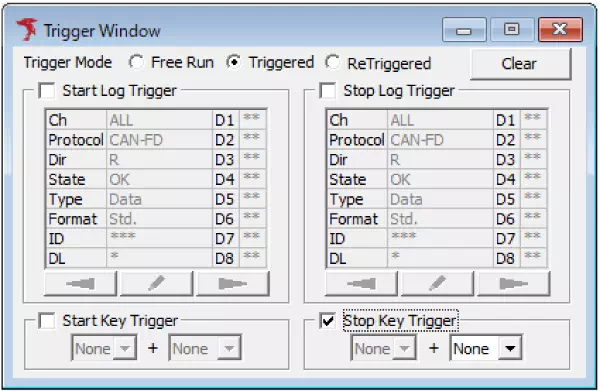
The example above enables Stop Key Trigger by checking its checkbox.
4. Set the Key Trigger conditions
Use the main key and sub-key drop-down menus to select the keys for the trigger condition.
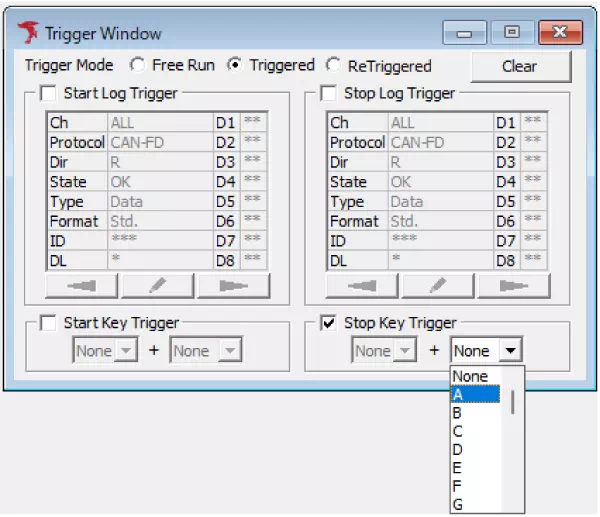
The example above uses the Space key as the stop Key Trigger condition.
For details of Key Trigger settings, see Key Trigger Controls.
5. Monitor
When monitoring starts, logging starts or stops in response to the key inputs configured as trigger conditions.
Trigger Window
The figure has Free Run selected. Log Triggers are at the top, Key Triggers in the middle, and Signal Triggers at the bottom. Start conditions are on the left and stop conditions on the right. No signal has been selected yet. Switch to Triggered or ReTriggered to configure conditions.
| Item | Description |
|---|---|
| Trigger Mode | Selects the trigger operating mode. • Free Run: Triggers disabled • Triggered: Operates once when conditions are met • ReTriggered: Repeats whenever conditions are met |
| Start Log Trigger | Starts log recording when log data is received as the trigger. Select the checkbox to enable. |
| Stop Log Trigger | Stops log recording when log data is received as the trigger. Select the checkbox to enable. |
| Start Key Trigger | Starts log recording on the specified key input. Select the checkbox to enable. |
| Stop Key Trigger | Stops log recording on the specified key input. Select the checkbox to enable. |
| Start Signal Trigger/Stop Signal Trigger | Starts/stops log recording based on signal threshold conditions. Select the target signal using Select Signal. |
| Clear button | Resets (deletes) all configured trigger conditions. |
Log Trigger Setting Dialog
Configure the log conditions to detect as a trigger.
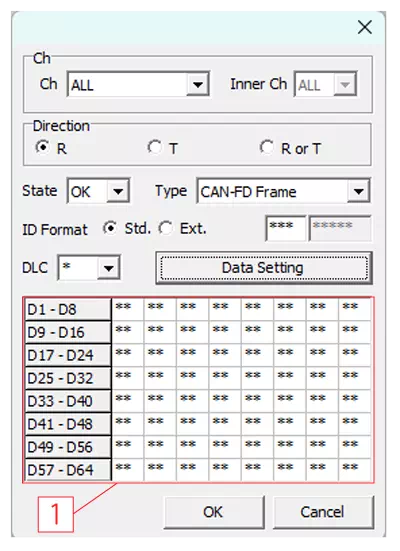
| Item | Description | Settings |
|---|---|---|
| Ch | Target channel (MicroPeckerX unit) | Select from the following drop-down options. ALL / 1 / 2 / 3 / 4 |
| InnerCh | Target channel (internal MicroPeckerX channel) | Select from the following drop-down options. ALL / 1 / 2 |
| Direction | Transmission/reception frames | R: Received frames / T: Transmitted frames / R or T: Both |
| State | Valid frames or error frames | Select from the following drop-down options. OK / NG |
| Type | Target frame type | Select from the following drop-down options. [When Status: OK is selected] • CAN-FD Frame • CAN Data Frame • Remote Frame [When Status: NG is selected] • All Error • Bus Error • Error Warning • Error Passive • Bus Off Entry • Bus Off Recovery • Overload • Bus Lock • Arbitration Lost • Stuff Error • Form Error • Ack Error • CRC Error • Recessive Bit Error • Dominant Bit Error • Ack Delimiter Error |
| ID Format | CAN ID format | Select standard (Std.) or extended (Ext.) CAN ID. CAN IDs are specified in Hex. Enter an asterisk (*) to skip CAN ID matching. |
| DLC | CAN data length | Enter an asterisk (*) to skip DLC matching. |
| Data Setting button | Opens the Data Setting dialog | - |
| [1] | Data section | Displays the data configured in the Data Setting dialog. |
Data Setting Dialog
Click Data Setting in the Log Trigger setting dialog to open the Data Setting dialog.
Configure data conditions for the log to detect as a trigger. Switch between Hex (hexadecimal) and Binary display using the tabs.
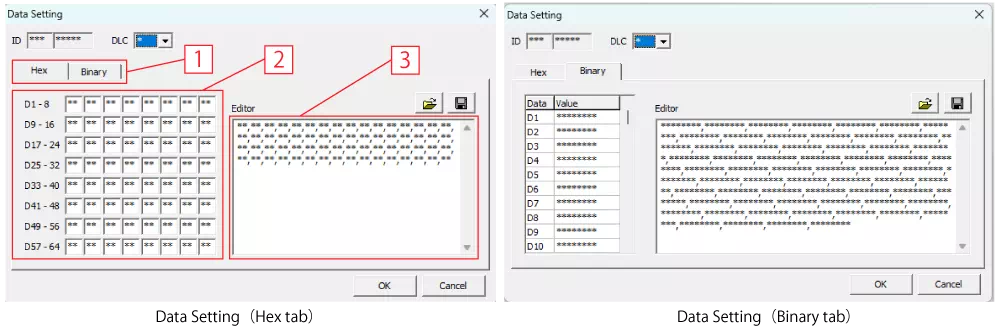
| Item | Description | Details |
|---|---|---|
| ID | CAN ID | The CAN ID cannot be edited in Data Setting. |
| DLC | Data length | The data setting areas [2] and [3] change according to the DLC setting. Enter an asterisk (*) to skip DLC matching. |
| [1] | Hex/Binary tabs | Switches the data display between Hex and Binary. |
| [2] | Byte-by-byte data setting area (Note 1) | Each cell represents one byte and can be edited. The upper-left cell is Data1. Enter an asterisk (*) to skip matching that data. |
| [3] | Editor area (Note 1) | Enter data as comma-separated bytes. Enter an asterisk (*) to skip matching that data. Settings can be saved to and loaded from a CSV file. |
 button | Load Data Setting configuration file | Loads a CSV file saved in Data Setting. |
 button | Save Data Setting configuration file | Saves Data Setting to a CSV file. The settings in [3] are saved. |
Note 1: Data can be edited in either [2] or [3]. The settings displayed in [2] and [3] are linked.
Key Trigger Controls
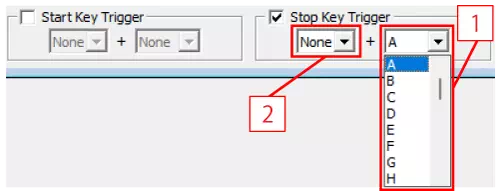
| Item | Description | Details |
|---|---|---|
| [1] | Main key | Sets the key to use as a trigger. Available keys: 0–9, A–Z, F1–F12, SPACE |
| [2] | Sub-key | Sets a modifier key to combine with the main key. Available keys: Shift, Ctrl, Alt |
Checking Recording Results
Check waiting, recording start, and recording stop states in the status bar. After stopping, check the target channel, times, and frames in the communication log at the specified destination. For Triggered and ReTriggered termination conditions, see Trigger Modes.
After stopping with the settings in Figure 1b, analyze the Signal Analysis Monitor buffer (trigger intervals 1) and set the Export CSV range to Selected trigger interval to check the recorded interval. Figure 2 shows the signal-value CSV output range confirmation screen.
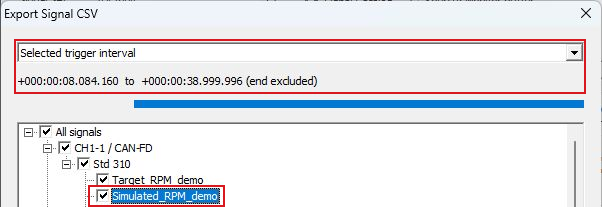
Figure 2: Checking one recorded interval using the signal-value CSV output range.
The interval starts at +000:00:08.084.160 and ends at +000:00:38.999.996, a difference of 30.915836 s. As indicated by end excluded on screen, the signal-value CSV excludes the end timestamp.
In the CH1-1 communication log CSV automatically saved by Save Log File (Offset 0), both the first and last records were received frames (R) on CH1-1 with ID 0x310. D3 and D4 represent actual rotational speed as a 16-bit Little Endian value.
- First: Time is
+000:00:08.084.160. D3 and D4 are98 08, representing2200 rpm. - Last: Time is
+000:00:38.999.996. D3 and D4 are06 07, representing1798 rpm.
This communication log CSV includes the final stop frame. The configured start threshold is 2200 rpm and the stop threshold is 1800 rpm, while the recorded stop value is 1798 rpm. Check the signal-value CSV selection range and the communication log CSV boundaries separately.
Forcing Logging to Start
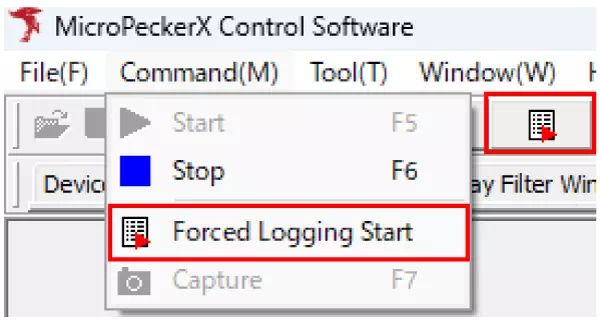
You can force logging to start before a logging start trigger is detected.
Select Command → Forced Logging Start from the menu bar.
You can also use the toolbar  button to force logging to start.
Status Bar Indicators
The status bar shows trigger waiting, recording, and stopped states. Figures 3–5 are actual screens captured with the Signal Trigger settings in Figure 1b.
On this screen, Last Trigger displays [Log] Logging Start/[Log] Logging Stop even when using Signal Triggers. Do not infer Log Trigger configuration from [Log] alone; check the enabled conditions in Figure 1b. Use Status on the left to check the current operating state.
At capture time, Values showed 1451 rpm while waiting (+000:00:02.464.888) and 2491 rpm while recording (+000:00:10.263.866). These are current readings at capture time. Check the configured thresholds in Figure 1b and actual recorded start/stop values in Recording Results.
Waiting for a Logging Start Trigger

Figure 3: Wait Start Trigger while waiting for the start condition.
Last Trigger is the most recently displayed trigger information. In Figure 3, check [Log] Logging Stop separately from the left-hand status indicating that the application is currently waiting to start.
Logging Started

Figure 4: Logging displayed after the start condition is met.
Logging Stopped

Figure 5: Display after stopping and saving completes.
With the Triggered settings in Figure 1b, meeting the stop condition stops recording and monitoring. Figure 5 displays Setting and Logging Complete..
The status bar displays trigger information when a logging start or stop trigger is detected.