Choosing Log Analysis Features and Basic Operations
| What to investigate | Feature to use |
|---|---|
| Signal values, waveforms, states, and source frames | Signal Analysis |
| Frame display and condition-based filtering | Analyze/Ch Log on this page and Filtering |
| Time, frame, and label searches | Log Search |
| Timing relationships across channels | Ch Mixing |
| Frame intervals | Frame Cycle Analysis |
| Gateway delay, loss, and residence | GW analysis operations and specifications |
To examine a saved communication log, load it without starting live monitoring. The Start/Stop procedure below is for analyzing data you are about to acquire.
Feature Overview
The data analysis features in MicroPeckerX CAN FD Analyzer let you analyze and visualize acquired log data from various perspectives. The main features are listed below.
| Feature | Description |
|---|---|
| Combined log analysis (Analyze tab) | Merge logs from multiple channels and analyze them together on a single timeline. – Combine multiple channel logs (Ch Mixing) – Filter display (Error/ID/Label) – Search logs (time/trigger/label) – Set/clear time offsets – Analyze CAN gateways (delay/message loss/residence) – Undo/Redo filtering – Load/save log buttons |
| Per-channel log analysis (Ch Log tab) | Analyze individual channel logs. – Filter display (Error/ID/Label) – Search logs (time/trigger/label) – Set/clear time offsets – Measure frame cycles (CAN Frame Analyze) – Load/save log buttons |
| Signal analysis (Signal Analysis tab) | Signal Analysis converts acquired logs to signal values, letting you inspect values/waveforms over time and corresponding source frames. |
| GW (Gateway) analysis | Measure frame delays, message loss, and peak residence through a CAN gateway. – Latency & Msg. Lost: maximum/minimum/average latency and loss occurrences – Residence Peak: peak resident frame count and its timing |
| Frame cycle analysis | Measure transmission intervals (cycles) of specified frames. – Display maximum/minimum/average intervals and sample counts – Save results to CSV |
| Advanced filtering and searching | Filter by Error, ID, or Label conditions. – Various search options, including time, log entries, and labels |
| Log loading/saving | Import/export log files in Analyze Window and on the Ch Log tab. – Overwrite existing logs or retain them when loading – UTF-8 multibyte support (conversion support when importing external logs) |
| Undo/Redo operations | When Undo/Redo buttons are enabled, undo/redo filtering on the Analyze tab. History holds up to five log states, including the displayed state. Completing Ch Mixing rebuilds history starting from the combined log. |
These features let you analyze large field-acquired logs from multiple perspectives to identify problems and evaluate performance efficiently.
Relationship to Signal Analysis
This page primarily describes frame-log display, searching, and combining. To investigate signal values/waveforms in saved logs, use Signal Analysis in Analyze Window. It is a separate screen from Signal Window, which displays the latest values during monitoring. For preparing signal definitions and Signal Sets, see Basic Signal Operations.

Switch to “Analyze” or “Ch Log” for frame logs, or “Signal Analysis” for signal values and waveforms.
See Signal Analysis basic operations, screen layout, and recording/exporting results.
Playback in Signal Analysis moves the displayed time through analysis results. It differs from transmission onto the bus using Log Replay in Simulation Window.
Basic Operations
1. Start communication monitoring
Select “Command” → “Start” to start monitoring. You can also use the  toolbar button or F5.
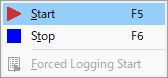
Basic operations, Figure 1. Start (F5) starts monitoring.
Start begins frame monitoring. To save logs to a file, turn on “Save Log File” before starting. In Free Run, recording begins when monitoring starts. If a start condition is configured in Triggered mode, “Wait Start Trigger” appears during monitoring; recording begins when the condition is met and the status changes to “Logging.” Recording conditions and status display
2. Stop communication monitoring
Select “Command” → “Stop” to stop monitoring. You can also use the  toolbar button, F6, or Esc.
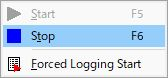
Basic operations, Figure 2. Stop (F6) stops monitoring.
3. Check logs in Analyze Window
Stop monitoring, open “Ch Log” in Analyze Window, and check frames on the target channel. If layout switching after stopping is enabled and acquired data exists, the layout switches to Analyze Layout.
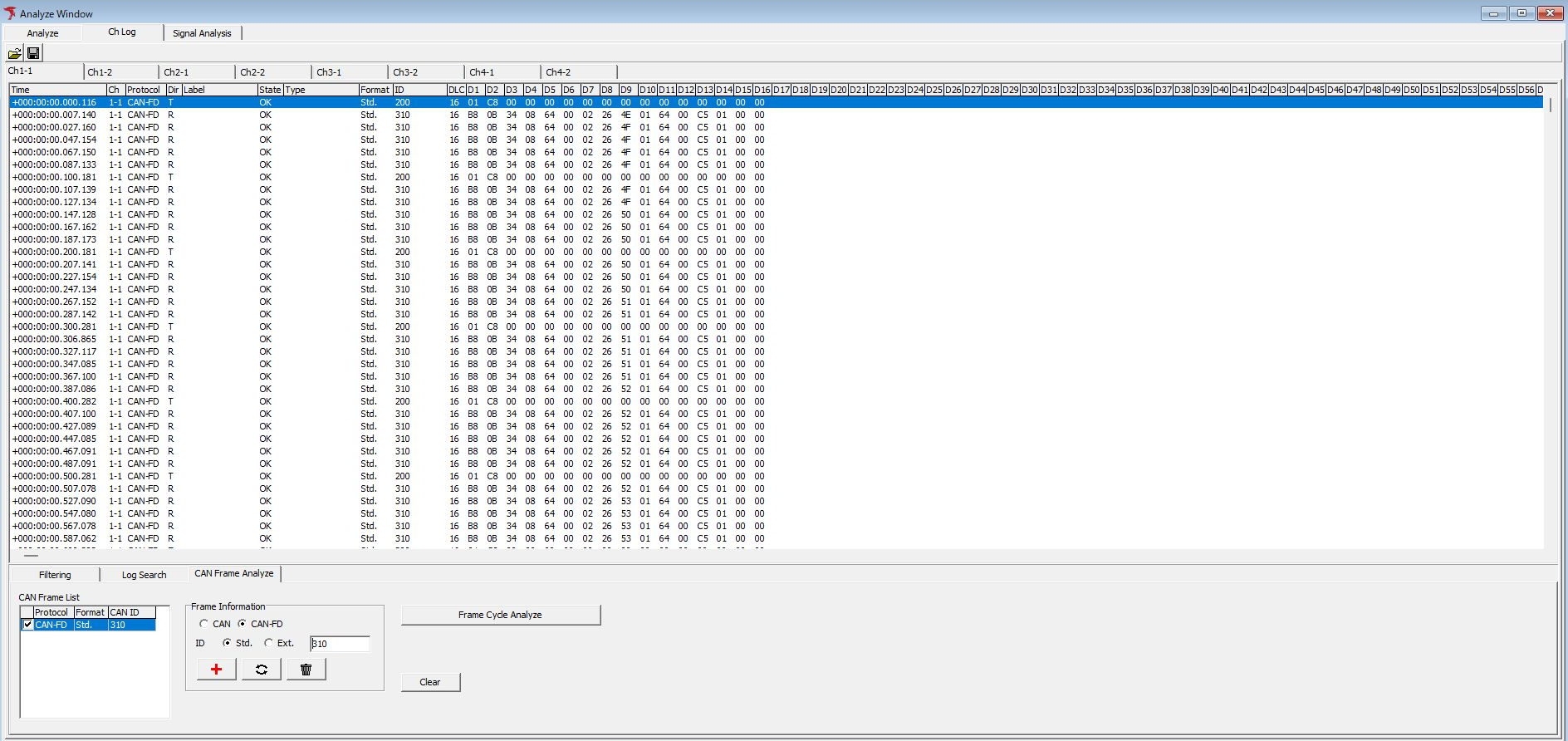
Basic operations, Figure 3. Frame log in Ch Log after stopping.
Analyze Window Reference
At the top of Analyze Window, switch between “Analyze” for combined channel logs, “Ch Log” for individual channels, and “Signal Analysis” for signal values/waveforms. The following examples display acquired logs. Numbers in each overview correspond to the table immediately below it.
Analyze Tab Display
In Analyze, first combine the target channel logs with Ch Mixing, then use filtering, searching, and CAN GW analysis.
Figure 1: Selecting channels to combine in Ch Mixing (excerpt)
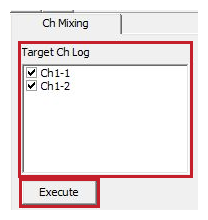
Select the target channels under Target Ch Log outlined in red, then combine logs with Execute. Both Ch1-1 and Ch1-2 are selected in the image.
Figure 2: Combined log after Ch Mixing
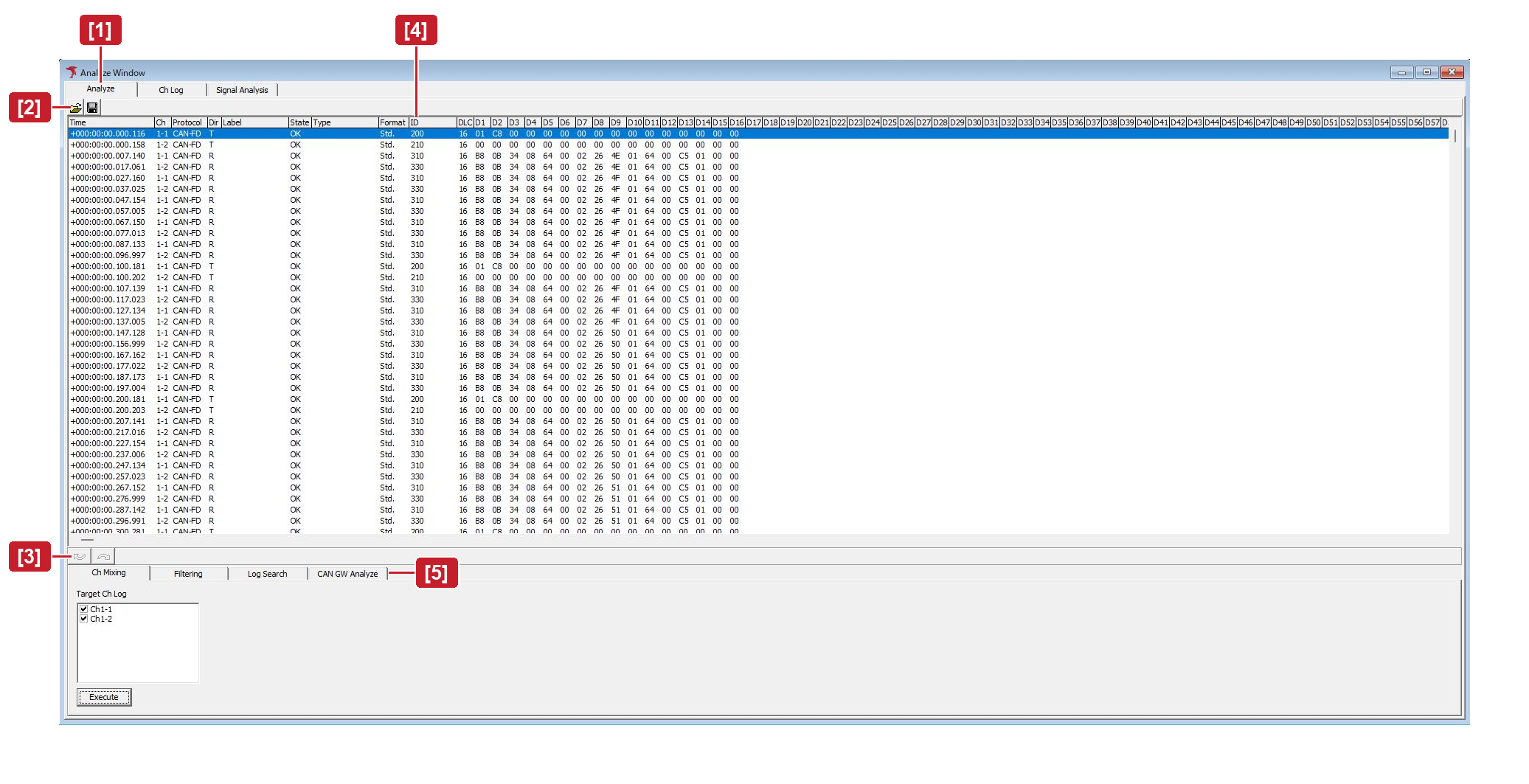
| No. | Item | Description |
|---|---|---|
| [1] | Analyze tab | Screen displaying the combined log. |
| [2] | Load Analyze Log / Save Analyze Log | Load/save combined logs. |
| [3] | Undo / Redo | Navigate filtering history. Completing Ch Mixing rebuilds history starting from the combined log. |
| [4] | Ch / ID columns in the combined log | Compare the source channel and CAN ID for each row. This example shows received ID 310 on CH1-1 in row 3 and received ID 330 on CH1-2 in row 4. The first selected row is a transmitted frame. |
| [5] | Ch Mixing / Filtering / Log Search / CAN GW Analyze | Select channel combining, filtering, searching, or gateway analysis. |
Tabs at the bottom vary with the log state. If Analyze has no combined log, start with Ch Mixing. For details, see Combining Multiple Channel Logs, Filtering, Log Search, and GW Analysis.
Ch Log Tab Display
In Ch Log, switch channels to inspect each channel's log. Changing the displayed channel is separate from selecting channels to combine in Analyze.
Figure 3: Overview displaying the CH1-1 log
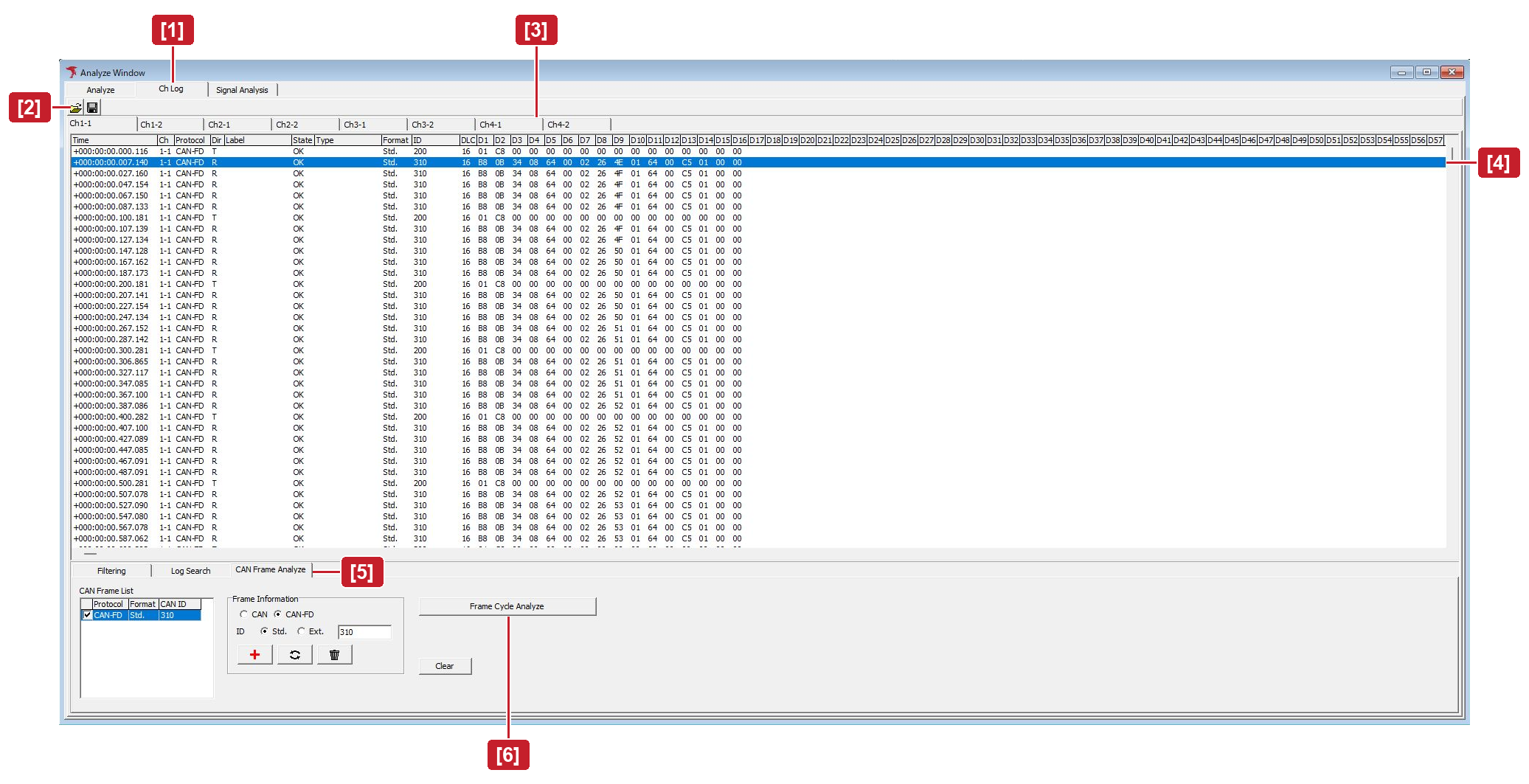
| No. | Item | Description |
|---|---|---|
| [1] | Analyze / Ch Log / Signal Analysis | Switch analysis screens. Ch Log is selected here. |
| [2] | Load Analyze Log / Save Analyze Log | Load a channel log or save the displayed log. |
| [3] | Channel display tabs | Select the channel to inspect, such as Ch1-1 or Ch1-2. Up to eight channels can be selected depending on the connected configuration. |
| [4] | Log list | Check Time, Ch, Protocol, Dir, ID, DLC, data, and other fields. The selected row is a received frame on CH1-1 with ID 310 (hexadecimal). |
| [5] | Filtering / Log Search / CAN Frame Analyze | Select filtering, searching, or frame cycle analysis within the channel. |
| [6] | CAN Frame Analyze settings | Register target IDs in CAN Frame List and analyze cycles using Frame Cycle Analyze. |
The selected row in Figure 3 is a received frame at Time “+000:00:00.007.140,” with DLC 16 and leading data “B8 0B.”
Figure 4: Switching to CH1-2 (excerpt)

Compare the Ch1-2 tab outlined in red with “1-2” in the selected row's Ch column. This received frame has ID 330 (hexadecimal). Distinguish it from CH1-1, ID 310, in Figure 3. For cycle analysis details, see Frame Cycle Analysis.
Signal Analysis Tab Display
In Signal Analysis, select the target log and Signal Set, then compare signal values/waveforms with frames.
Figure 5: Overview comparing two channels in four graph Areas
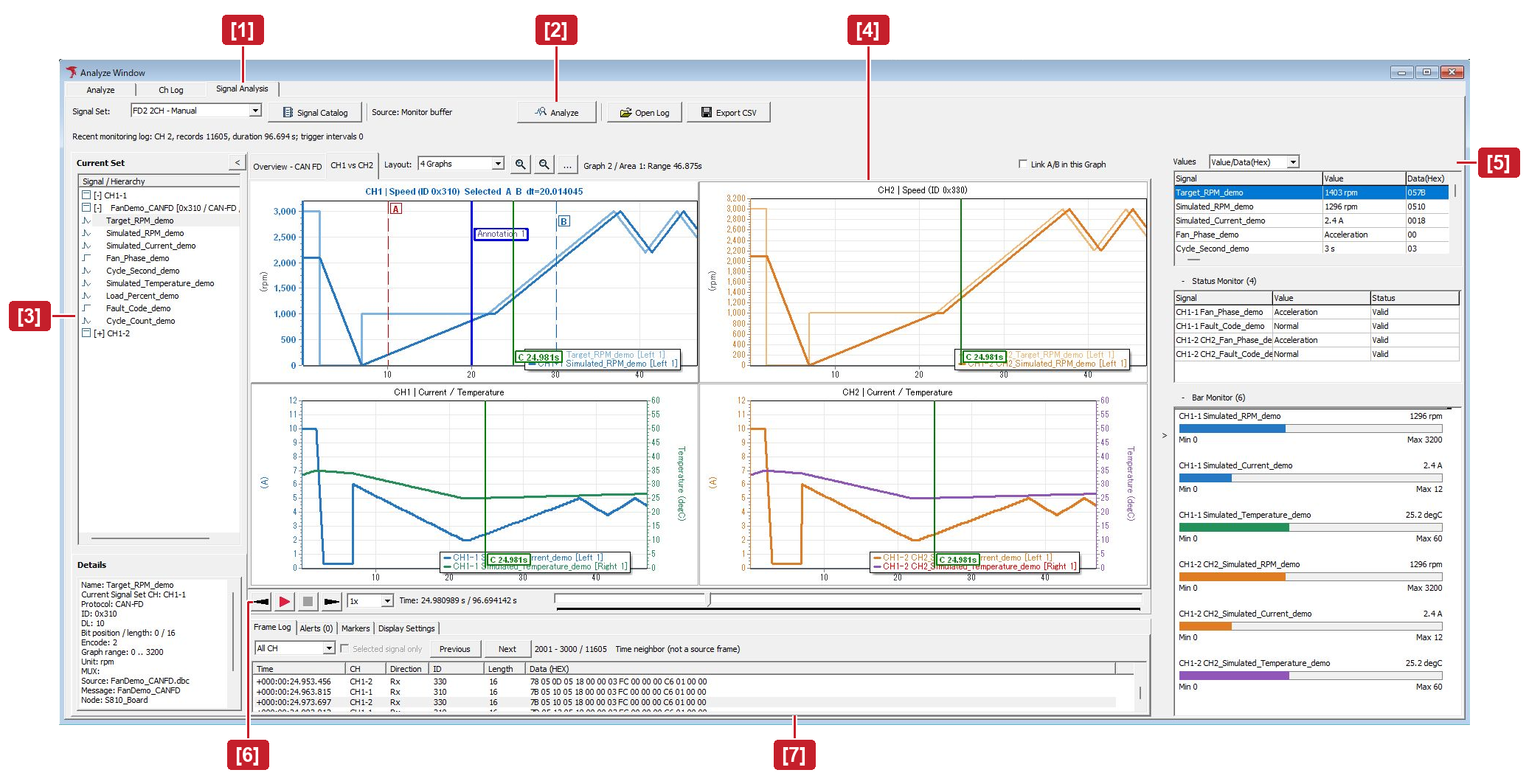
| No. | Item | Description |
|---|---|---|
| [1] | Analyze / Ch Log / Signal Analysis | Switch analysis screens. Signal Analysis is selected here. |
| [2] | Signal Set / Signal Catalog / Source / Analyze | Check signal definitions and the analysis source, then run Analyze. The example uses Signal Set “FD2 2CH - Manual” and Source Monitor buffer. Open Log loads a log, and Export CSV exports analyzed signal values. |
| [3] | Current Set / Details | Select a signal and check its definition, assigned channel, unit, and other details. |
| [4] | Graph tabs / Layout / graphs | Switch the displayed graph and division count. This example compares CH1-1 ID 0x310 and CH1-2 ID 0x330 in four Areas. |
| [5] | Values / Status Monitor / Bar Monitor | Check signal values, states, and bars at the displayed time. Target_RPM_demo is 1403 rpm at about 24.981 seconds in the image. |
| [6] | Playback controls / time slider | Move the displayed time through the recorded log. |
| [7] | Frame Log / Alerts / Markers / Display Settings | Switch between frames, alerts, A/B markers/annotations, and display settings. |
“Time neighbor (not a source frame)” in Frame Log indicates a frame near the displayed time. It does not identify the source frame that generated the selected signal's value. Check the channel, ID, time, and Selected signal only setting when comparing.
For procedures, see Basic Signal Analysis Operations; for waveforms, values, and markers, see Screen Layout and Checking Waveforms; for saving, see Recording and Exporting Results.