Communication Settings
Use Device Window to configure communication settings for the connected MicroPeckerX. Always configure these settings before starting monitoring.
Basic Operation
The following procedure describes how to configure communication settings.
- Open Device Window
Select Device Window from the menu or toolbar.
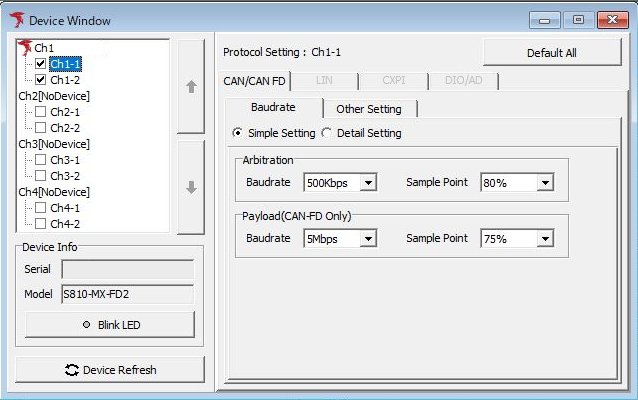
Serial numbers are omitted in the figure.
-
Select the channel to configure
Click a connected channel (Ch1-1 or Ch1-2) to display its communication settings in Protocol Setting.
When connecting MicroPeckerX to multiple CAN bus channels, configure communication settings for each channel. -
Configure Baudrate
On the Baudrate tab in Protocol Setting, select the CAN bus baud rate and sample point from the presets.
Payload settings apply only to CAN FD.
- Configure Ack responses and termination
On the Other Setting tab in Protocol Setting, enable or disable Ack responses from MicroPeckerX and turn the termination resistor on or off.
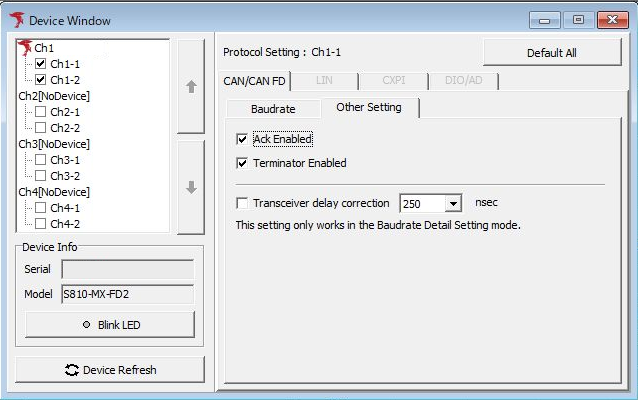
Communication setup is now complete.
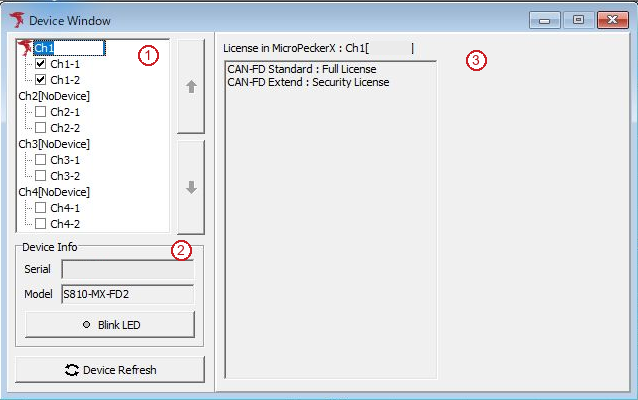
Device Window
| No. | Item name | Description |
|---|---|---|
| 1 | Device List | Displays a list of connected MicroPeckerX units. Use the checkboxes to enable or disable each channel. |
| Up/down buttons | When multiple MicroPeckerX units are connected, select a unit and click the up/down buttons to change its channel assignment. | |
| 2 | Device Info | Displays the serial number and model of the MicroPeckerX selected in Device List. |
| Serial | Displays the serial number of the selected MicroPeckerX. | |
| Model | Displays the model of the selected MicroPeckerX. | |
| Blink LED button | Blinks the LEDs on the MicroPeckerX selected in Device List so you can identify the unit. Click Blink LED to blink the green and yellow LEDs on the selected MicroPeckerX. Click Blink LED again to stop blinking. | |
| Device Refresh button | Click to detect MicroPeckerX units connected to the PC again. | |
| 3 | Protocol Setting | Displays the licenses registered on the MicroPeckerX selected in Device List. Displays No Device if no device is detected. Click a channel in Device List to display its communication settings. |
Baudrate Tab
Click a channel in Device List to display its communication settings. On the Baudrate tab, you can configure the baud rate and sample point.
Simple Setting provides easy setup using presets; Detail Setting provides detailed configuration.
Simple Setting
In Simple Setting, select CAN/CAN FD communication settings from the drop-down lists.
| Item name | Description | |
|---|---|---|
| Protocol Setting | Displays information for the selected channel. | |
| Baudrate/Other Setting tabs | Switches Protocol Setting between Baudrate and Other Setting. | |
| Simple Setting / Detail Setting | Switches the communication configuration method. Simple Setting selects presets; Detail Setting sets bit timing directly. | |
| Arbitration (Note 1) | Baudrate | Sets the baud rate. Select from the following values in the drop-down list: 1 M、500 k、250 k、125 k [bps] |
| Sample Point | Sets the sample point. Select from the following values in the drop-down list: 60、65、70、75、80、85 [%] | |
| Payload (CAN FD Only) (Note 2) | Baudrate | Sets the CAN FD payload baud rate. Select from the following values in the drop-down list: 5 M、4 M、2 M、1 M、500 k [bps] |
| Sample Point | Sets the sample point. Select from the following values in the drop-down list: 60、70、80 [%] | |
| Default All button | Click to restore Protocol Setting for the selected channel to its defaults. The default values are as follows. • Arbitration: Baudrate: 500Kbps, Sample Point: 80% • Payload (CAN FD Only): Baudrate: 2Mbps, Sample Point: 80% | |
Note 1: The available Sample Point combinations depend on Baudrate.
Note 2: Available for CAN FD only. The available Payload Baudrate/Sample Point combinations also depend on the Arbitration Baudrate.
Detail Setting
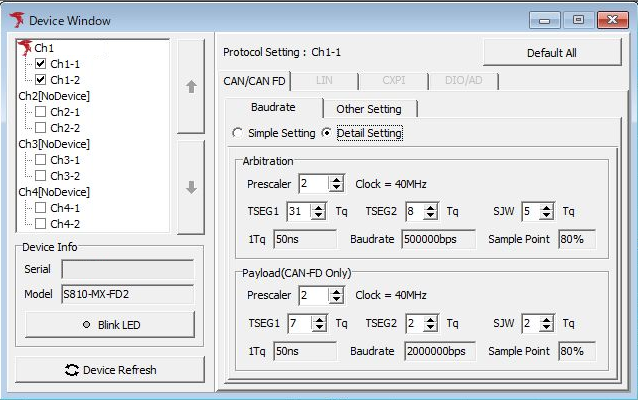
Detail Setting lets you configure CAN/CAN FD communication timing in detail using Prescaler, TSEG1, TSEG2, and SJW.
Changing a setting automatically recalculates and displays 1Tq, Baudrate, and Sample Point.
Normally use Simple Setting; use Detail Setting when you need to match the bit timing of the connected device.
| Item name | Description |
|---|---|
| Arbitration | Sets the communication timing for the arbitration phase. |
| Payload (CAN FD Only) | Sets the communication timing for the CAN FD payload. Available only when using CAN FD. |
| Prescaler | The CAN clock division factor. Affects the duration of 1Tq. |
| TSEG1 | Sets the time segment before the sample point in Tq units. |
| TSEG2 | Sets the time segment after the sample point in Tq units. |
| SJW | Sets the maximum timing adjustment during resynchronization in Tq units. |
| 1Tq | Displays the duration of 1Tq calculated from Prescaler. |
| Baudrate | Displays the baud rate calculated from Prescaler, TSEG1, and TSEG2. |
| Sample Point | Displays the sample point calculated from TSEG1 and TSEG2. |
Calculations use a 40 MHz clock.
Baudrate is calculated as 40 MHz / Prescaler / (1 + TSEG1 + TSEG2), and Sample Point as (1 + TSEG1) / (1 + TSEG1 + TSEG2).
The setting ranges are as follows.
| Target | Prescaler | TSEG1 | TSEG2 | SJW |
|---|---|---|---|---|
| Arbitration | 1~1024 | 4~128 | 2~32 | 1~32 |
| Payload (CAN FD Only) | 1~256 | 2~16 | 2~8 | 1~8 |
The default values are as follows.
| Target | Prescaler | TSEG1 | TSEG2 | SJW |
|---|---|---|---|---|
| Arbitration | 2 | 31 | 8 | 5 |
| Payload (CAN FD Only) | 2 | 7 | 2 | 2 |
Other Setting Tab
On the Other Setting tab, you can enable or disable Ack responses from MicroPeckerX, turn its termination resistor on or off, and configure transceiver delay correction.
| Item name | Description |
|---|---|
| Protocol Setting | Displays information for the selected channel. |
| Baudrate/Other Setting tabs | Switches Protocol Setting between Baudrate and Other Setting. |
| Ack Enabled | Select whether MicroPeckerX sends Ack responses. Always select this checkbox when using simulation transmission. |
| Terminator Enabled | Turns the MicroPeckerX termination resistor on or off. Select the checkbox to turn termination on. |
| Transceiver delay correction | Enables transceiver delay correction. Available only with Detail Setting. When checked, the delay selected on the right is used as the correction value. |
| Transceiver delay correction delay time | Select the delay used for transceiver delay correction in nsec. The range is 25–1600 nsec in 25 nsec increments. The default is 250 nsec. |
| Default All button | Click to restore Protocol Setting for the selected channel to its defaults. The default values are as follows. • Ack Enabled: Enable • Terminator Enabled: Disable • Transceiver delay correction: Disable • Transceiver delay correction delay time: 250 nsec |
Importing communication definitions into the Catalog is separate from the device settings on this page. Importing a DBC does not configure the baud rate, termination resistor, or transmission behavior; check these settings against the connected system.