Save and Load Settings
You can save the GUI application's settings to a file and load them from a saved file.
What Each Signal-Related File Saves
| Format | Saved content | Content not included | Load destination and scope | Checks when using another device |
|---|---|---|---|---|
| Standard settings (MPXXML) | Common and device-specific settings selected in Save Config | Unselected items, the entire Catalog and all Sets, communication logs | Applies the items selected in Load Config | If the serial number differs, check the source and destination channels in Ch Config Import |
| Signal settings (MPXSIG) | Definitions and all Sets saved with Save in the shared Catalog | Communication logs, analysis results, standard settings | Load in the shared Catalog replaces the Catalog and all Sets. In the definition selection screen for analysis, use Load Signal Set | Reassign channels if Load in the shared Catalog clears their assignments |
| Communication log CSV | Original communication frames and timestamps | Signal definitions and converted signal values | Log input in Analyze or a supported Log Replay mode | Check the channel, communication type, and corresponding definitions |
| Analysis CSV | Selected range, signal values and validity, and source frame information | All communication frames, definitions, annotations | For use in spreadsheet software and similar tools; not for restoring communication logs or settings | Check the definitions, units, and output range together |
| Alert History CSV | History of alerts raised during monitoring | Alert condition definitions, original communication frames | For reviewing history; restore conditions from MPXSIG or another settings file | Check signal names, condition names, and the settings used during acquisition |
| Window layout | Window positions | Definitions, graph axis settings, analysis values | Select a saved layout from the Layout menu | Check screen dimensions and display positions |
| Graph image | Appearance of the selected Area | Data for reanalysis, signal definitions | View as an image | Also record the log name, time range, and units |
| Analysis annotations | Retained within the analysis session for the open log | Saving annotations in MPXSIG or analysis CSV | Cannot be used to restore annotations in another session | Record any required timestamps, titles, and comments separately |
Signal-Related Items in MPXXML
- Signal Monitor Setting saves and applies the signal definitions and display settings expanded to devices and channels from the settings in use. To retain other Sets and unused definitions as well, save an MPXSIG file from the shared Catalog.
- Trigger Setting saves and applies start and stop conditions, including Signal Triggers. If signal definitions or channel assignments have changed, check the target and thresholds using Select Signal after loading.
- Simulation Setting saves and applies slot settings and the definitions adopted for transmission settings. When loading them onto another device, follow the pre-transmission checks to verify the target channel, frame conditions, cycle, enabled state, and initial data.
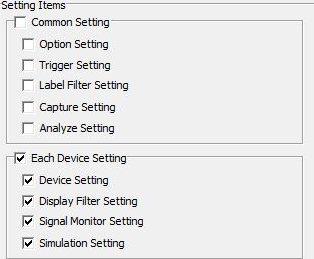
The items selected in Load Config are applied. After loading, check the connected devices and channels, Current Set, definitions to use, and display destinations.
When Signal Settings Cannot Be Loaded
At startup, the application restores the Current Set automatically saved at the previous exit. Device → Refresh rechecks the assignments of the current Set. Depending on the connected devices, only some channels may be restored. If a channel is disconnected, or the same physical channel maps to a different channel number than when saved, Signal Monitor Setting cannot be selected in either Load Config or Ch Config Import. Other load items remain available. Restore the device and channel configuration used when saving, run Refresh, and check the status bar notifications.
After loading Signal Monitor Setting from MPXXML, if not all target devices and internal channels in the file can be identified, applying the loaded settings to the Current Set is deferred. Reconnect all devices indicated in the status bar and synchronize them with Refresh. During this time, Signal Monitor Setting cannot be selected in Ch Config Import. You can still load different settings using Load Config.
Saving Settings
- Open the Save Config dialog
Select File → Save Configuration from the menu to open the Save Config dialog.
You can also click the toolbar button to open the Save Config dialog.

- Select the settings to save
Use the checkboxes in the Save Config dialog to select the settings you want to save.
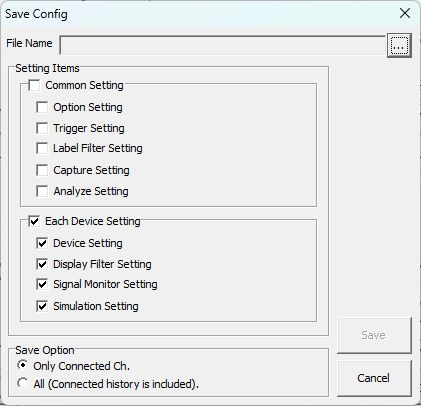
- Specify a file name and save
Click the ... button to the right of File Name to open the file save dialog, then specify the file name and destination. Click Save to save the settings to the file and close the Save Config dialog.
Save Config Dialog
The Save Config dialog saves settings from each window and the Option dialog to a configuration file.
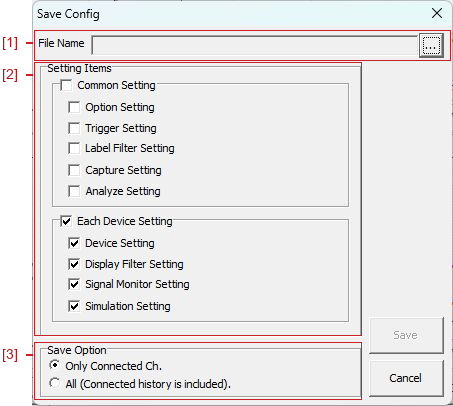
| No. | Item | Description |
|---|---|---|
| [1] | File Name | Displays the configuration file's destination path and file name. Click the  button to open the file selection dialog and specify the destination folder and file name for the configuration file. |
| [2] | Setting Items | Select the settings to save. |
| Common Setting | Select whether to save all settings in Option Setting, Trigger Setting, Label Filter Setting, Capture Setting, and Analyze Setting. | |
| Option Setting | Select whether to save the Option dialog settings. | |
| Trigger Setting | Select whether to save the Trigger Window settings. | |
| Label Filter Setting | Select whether to save the Label Filter Window settings. | |
| Capture Setting (Note 1) | Select whether to save the Capture Window settings. | |
| Analyze Setting | Select whether to save the Analyze Window settings. | |
| Each Device Setting | Select whether to save all settings in Device Setting, Display Filter Setting, Signal Monitor Setting, and Simulation Setting. | |
| Device Setting | Select whether to save the Device Window settings. | |
| Display Filter Setting | Select whether to save the Display Filter Window settings. | |
| Signal Monitor Setting | Select whether to save the Signal Window settings. | |
| Simulation Setting | Select whether to save the Simulation Window settings. | |
| [3] | Save Option | Save options. |
| Only Connected Ch. | Select whether to save information for connected channels. | |
| All (Connected history is included). | Select whether to save information for all channels, including connection history. | |
| - | Save button | Saves the settings. |
| - | Cancel button | Closes the Save Config dialog without saving settings. |
Note 1: Capture Setting is under development and is not available.
Loading Settings
- Open the Load Config dialog
Select Load Configuration from the menu to open the Load Config dialog.
You can also click the toolbar button to open the Load Config dialog.

- Open the configuration file
Click the file selection button in the Load Config dialog and open the saved configuration file.
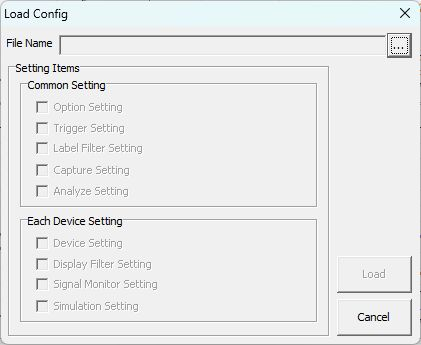
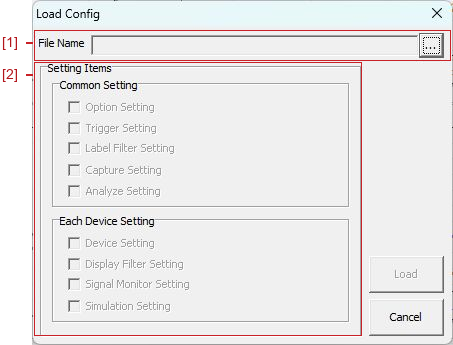
The figure shows the state before a configuration file is selected. Once a file is specified, its saved items become selectable.
-
Select the settings to load
Use the checkboxes in the Load Config dialog to select the settings to apply. -
Load the settings
Click Load to apply the selected settings to the application and close the Load Config dialog.
Behavior When Loading a Configuration File
When the File Contains the Device Information
Settings matching the serial number of the connected MicroPeckerX are loaded.

Unselected Settings
Items unchecked in the Load Config dialog are not loaded from the configuration file; their current GUI application settings remain unchanged.
When the File Does Not Contain the Device Information
If the connected MicroPeckerX information (serial number) is not present in the configuration file, you are asked whether to open the Ch Config Import dialog.

Selecting Yes first applies the selected common settings, then opens the Ch Config Import dialog. For device-specific settings, select the source and destination channels and the settings to import, then apply them with Import.
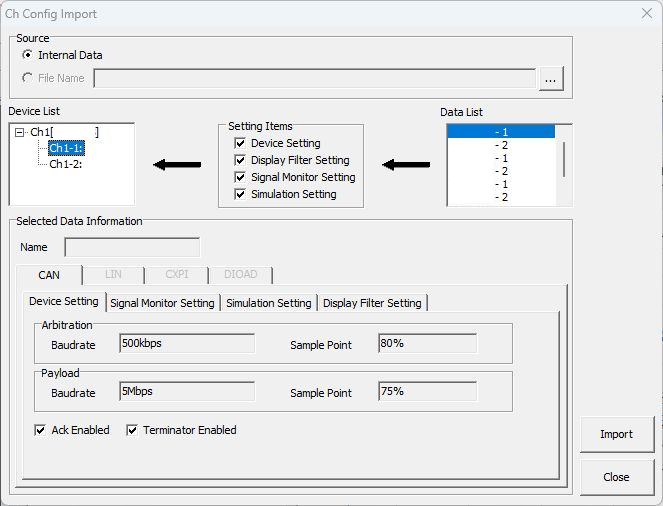
The figure shows an example before Import is executed. Serial numbers are omitted. Settings applied with Import remain in effect even if you close the dialog with Close.
Configuration Loading Diagram
If the configuration file does not contain information for the connected MicroPeckerX, apply the settings selected in the Ch Config Import dialog.

Note: The Ch Config Import dialog applies settings to individual channels.
Load Config Dialog
The Load Config dialog loads settings for each window and the Option dialog from a configuration file.
| No. | Item | Description |
|---|---|---|
| [1] | File Name | Displays the configuration file's destination path and file name. Click the button to open the file selection dialog and specify a saved configuration file. After loading the file, its saved setting items are checked. |
| [2] | Setting Items (Note 1) | Select the settings to load. |
| Common Setting | Common setting items. | |
| Option Setting | Select whether to load the Option dialog settings. | |
| Trigger Setting | Select whether to load the Trigger Window settings. | |
| Label Filter Setting | Select whether to load the Label Filter Window settings. | |
| Capture Setting (Note 2) | Select whether to load the Capture Window settings. | |
| Analyze Setting | Select whether to load the Analyze Window settings. | |
| Each Device Setting | Device-specific setting items. | |
| Device Setting | Select whether to load the Device Window settings. | |
| Display Filter Setting | Select whether to load the Display Filter Window settings. | |
| Signal Monitor Setting | Select whether to load the Signal Window settings. If this cannot be selected, see “When Signal Settings Cannot Be Loaded.” | |
| Simulation Setting | Select whether to load the Simulation Window settings. | |
| - | Load button | Applies the settings to the GUI application. |
| - | Cancel button | Closes the Load Config dialog without applying settings to the GUI application. |
Note 1: Items not saved in the configuration file cannot be selected in Setting Items.
Note 2: Capture Setting is under development and is not available.
Ch Config Import Dialog
You can apply channel-specific settings to a channel on a connected MicroPeckerX.
The figure shows an example before Import is executed. Serial numbers are omitted. Settings applied with Import remain in effect even if you close the dialog with Close.
| Menu item | Description |
|---|---|
| Internal Data | Retrieves information from connected MicroPeckerX units. |
| File Name | Retrieves settings from a configuration file. |
| Device List | Displays the currently connected MicroPeckerX units. |
| Setting Items | Select the settings to load. |
| Data List | Specify the source device information to import from the configuration file. |
| Selected Data Information | Displays the settings selected in Data List. |
| Device Setting | Displays settings for Device Window. |
| Display Filter Setting | Displays settings for Display Filter Window. |
| Signal Monitor Setting | Displays settings for Signal Window. If this cannot be selected, see “When Signal Settings Cannot Be Loaded.” |
| Simulation Setting | Displays settings for Simulation Window. |
| Import button | Immediately applies the selected settings to the target channel. The dialog remains open so you can continue applying settings to other channels. |
| Close button | Closes the dialog. Channel settings applied with Import and common settings applied earlier remain in effect. |