Labels
Labels assign names and colors to matching frame logs. To map raw signal values to Logical state names such as Off/On, use Signal Definitions.
In Label Filter Window, configure target frame conditions and label names, text colors, and background colors to identify frames easily in Monitor Window, Each ID Window, and Analyze Window.
Label Filter Window
Figure 1 shows SensorFrame moved to the top and enabled. Conditions higher in Filter List have priority; the label of the first matching enabled condition is used.
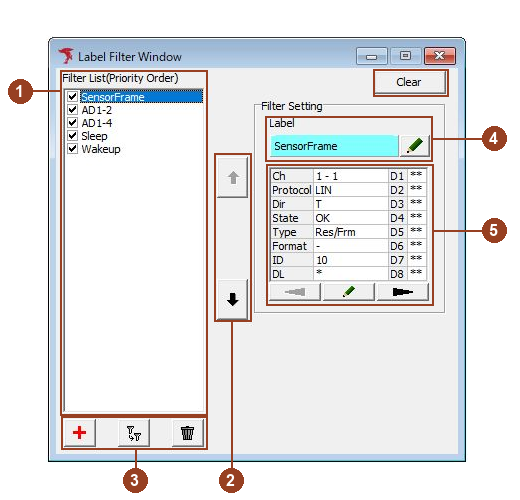
Figure 1: Label Filter Window areas.
| No. | Item | Description |
|---|---|---|
| ① | Filter List (Priority Order)/Clear | Each row's checkbox enables/disables the label condition. If multiple enabled conditions match, the higher condition takes priority. Clear deletes all label filters in the list. |
| ② | Up/down arrows | Moves the selected condition up/down to change its priority. |
| ③ | Add/copy/delete | + adds a new condition. Copy and delete apply to the selected condition. |
| ④ | Label preview and pencil button | Check the selected label's name and colors. Click the pencil button or double-click the preview to open Label Setting and edit the name, text color, and background color. |
| ⑤ | Condition summary, pencil button, and left/right page buttons | Check the selected label's conditions. Click the pencil button or double-click the summary to open Filter Setting. Use the left/right buttons to switch condition display pages. |
Basic Operation
Here, assign SensorFrame with black text and a light blue background to valid LIN transmitted Response frames with ID 10 (hexadecimal 0x10) on Ch1-1. Use the same stopped log to compare the display before and after changing label priority and checkboxes.
- Open Label Filter Window
Open Label Filter Window from the menu or toolbar. - Add the target frame conditions
Click + in area ③ of Figure 1 to open Filter Setting. NewFilter5 in the title in Figure 2 is a temporary name for the newly added label. Configure the following conditions and click OK.
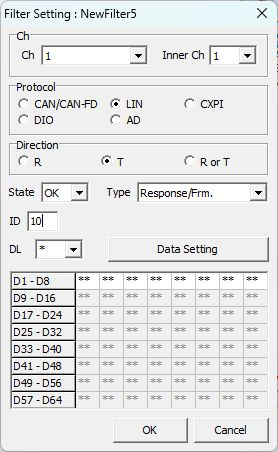
Figure 2: Conditions for Ch1-1 LIN transmitted Response, ID 10.
| Item | Setting | Meaning |
|---|---|---|
| Channel | Ch 1/Inner Ch 1 | Targets Ch1-1. |
| Protocol | LIN | Targets LIN frames. |
| Direction | T | Targets transmitted frames. |
| State | OK | Targets valid frames. |
| Type | Response/Frm. | Targets Response, not Header. |
| ID | 10 | Specifies hexadecimal 0x10. |
| DL | * | Does not restrict targets by data length. |
| D1~D8 | ** | Does not restrict targets by data values. |
Use Data Setting to specify byte-by-byte data conditions as needed. Settings such as CH, Protocol, and Direction are shared with the Trigger Setting dialog.
- Set the label name and colors
Select the added condition in Filter List and click the pencil button in area ④ of Figure 1 to open Label Setting. Set the name to SensorFrame, use the button to set black text, and the
 button to set a light blue background. Check Sample and click OK; the name in Filter List also changes to SensorFrame.
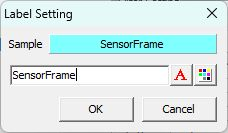
Figure 3: Setting the label name, text color, and background color.
The label name field accepts up to 24 characters. Keep the encoded length within 31 bytes when saving. If using only full-width characters that take two bytes in CP932, the limit is 15 characters.
- Check the display before prioritizing the specific label
Figure 4 shows a stopped Ch1-1 log. Check the first Response row: Time+0000010.002580, Protocol LIN, Dir T, State OK, ID10, DLC 2, D1/D2 18 01, and CS E6. This row shows the existing AD1-2 label with a yellow background.
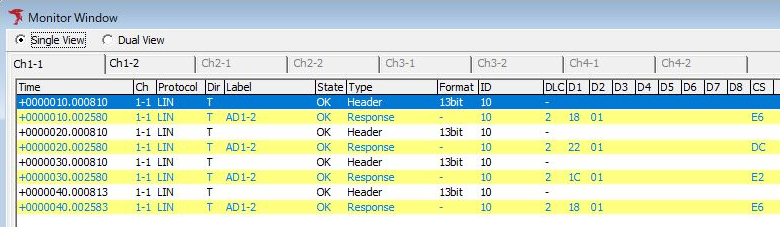
Figure 4: Before prioritizing the specific label.
- Move SensorFrame to the top and enable it
Select SensorFrame in Filter List, use the up arrow in area ② of Figure 1 to move it to the top, and check it. Keep the existing AD1-2, AD1-4, Sleep, and Wakeup enabled. When multiple conditions match the same frame, SensorFrame at the top takes priority. - Check the label change in the same log
Figure 5 shows the same stopped log as Figure 4. The Response row at+0000010.002580retains its time, CH, direction, ID, and data, while Label changes from AD1-2 to SensorFrame in black text and the background becomes light blue. Both figures also show 22 01 at+0000020.002580, allowing you to verify that they show the same log.
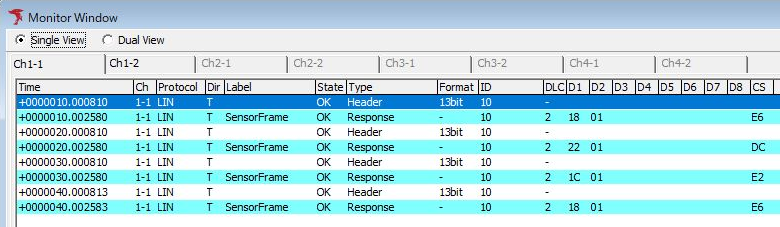
Figure 5: After setting priority and checkboxes.
Since this example uses Response/Frm., Header rows have blank Label fields both before and after. In addition to names and colors, check the frame types included in the condition.
Communication log CSV outputs the label name of the first matching enabled label filter condition, evaluated from the top at save time. Text and background colors are used for screen display. See also Communication Log Columns.