Master Simulation
Master Simulation allows operations such as transmitting headers to slave nodes.
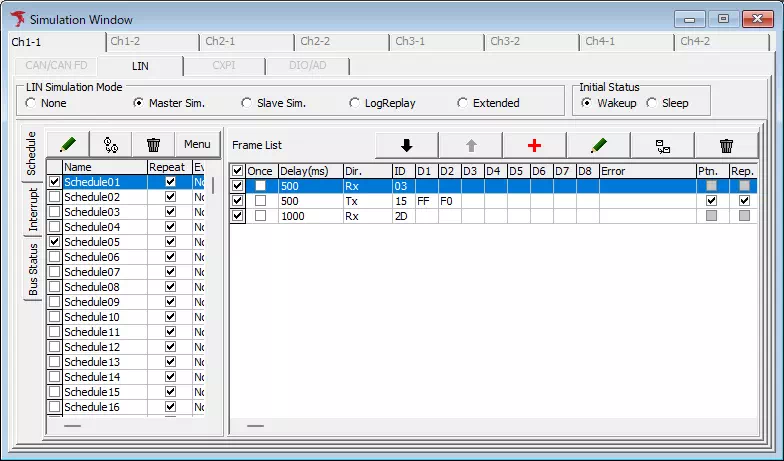
Select Master Sim. in LIN Simulation Mode of Simulation Window to use this function.
Basic Operation of Master Simulation
The following describes the setup flow when using schedule transmission in Master Simulation.
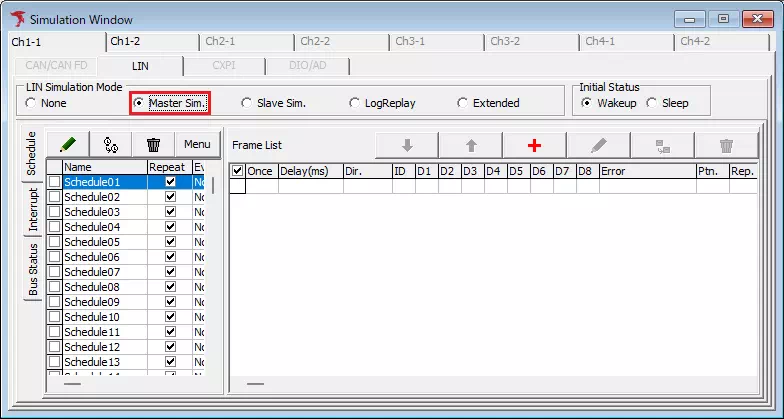
- Select Master Sim. in Simulation Window
Open Simulation Window from menu/toolbar and selectMaster Sim.inSimulation Mode.
Master Simulation is now available.
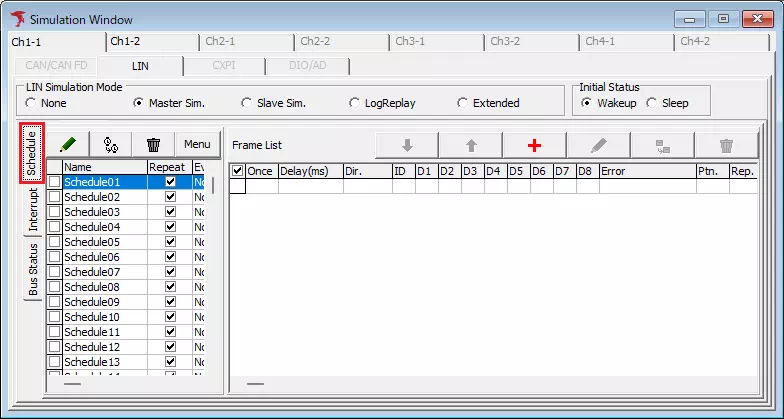
- Open schedule settings
ClickScheduletab.
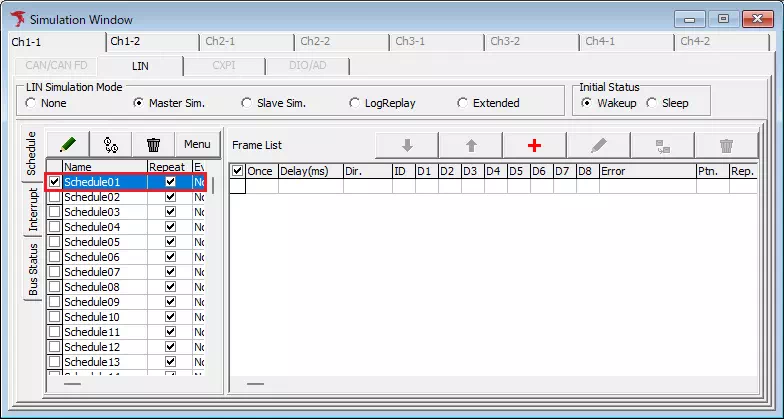
- Enable schedule
In the schedule list on the left, select a schedule and turn ON the leftmost checkbox on that row.
The selected schedule becomes active, and frames registered in that schedule are shown in the frame list on the right.
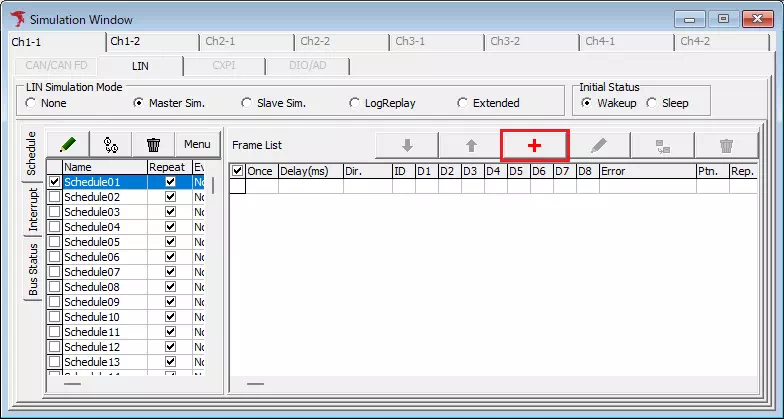
- Open LIN Frame Setting dialog
Click in Simulation Window.
LIN Frame Setting dialog appears.
- Configure frame information
Set frame information inFrame Settingof LIN Frame Setting dialog.
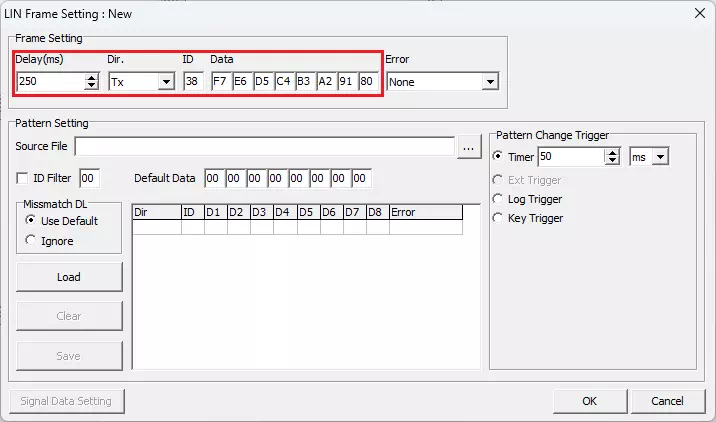
Minimum required items and examples:
| Item | Description | Example |
|---|---|---|
| Delay | Enter transmission interval from previous frame. | 250 |
| Dir. | Select frame type. | Tx |
| ID | If Dir. is Tx or Rx, enter LIN ID. | 38 |
| Data | If Dir. is Tx, enter response data. | F7 E6 D5 C4 B3 A2 91 80 |
- Register frame information
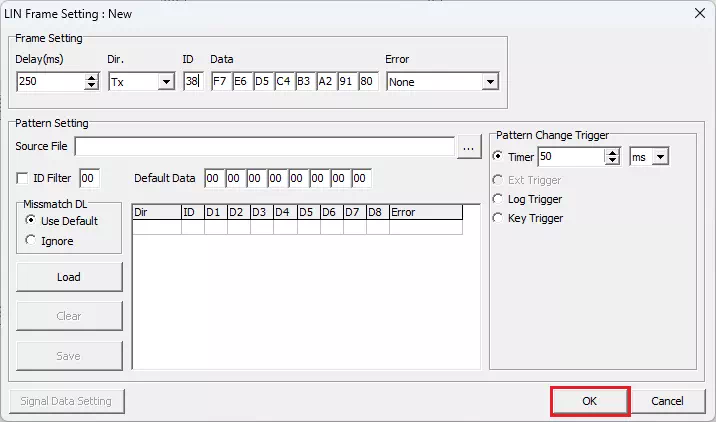
Click in LIN Frame Setting dialog.
Configured frame is registered and shown in frame list of Simulation Window.
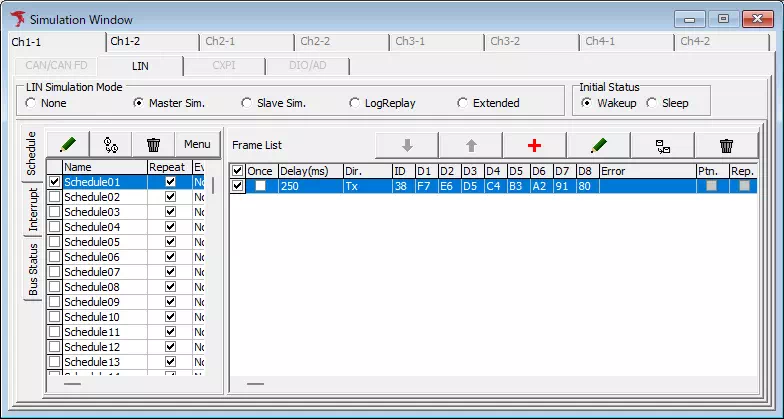
If the leftmost checkbox of a frame row in frame list is OFF, that frame is treated as disabled and will not be transmitted.
Checkbox states can be changed even during monitoring.
- Start monitoring
Click on toolbar (or select
 Command-Startfrom menu bar, or pressF5).
Monitoring starts and registered frames are transmitted.
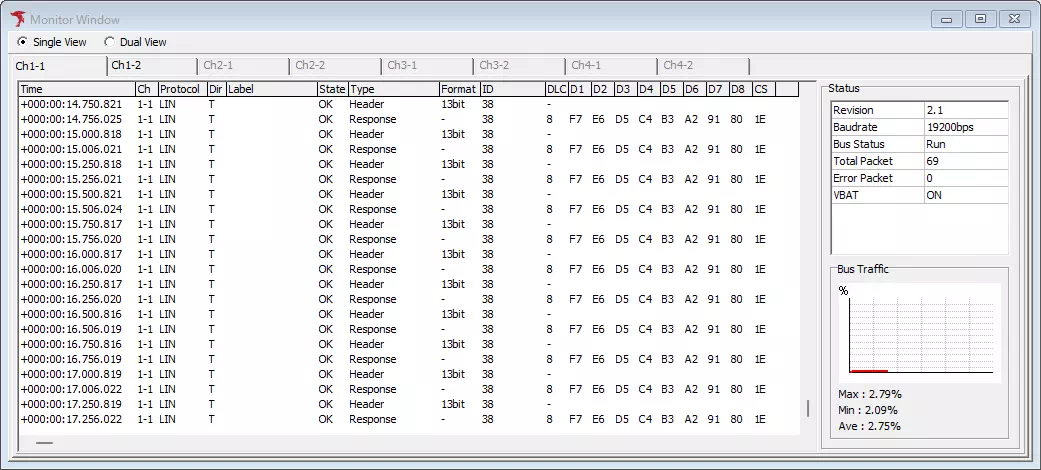
Master Simulation Screen Description
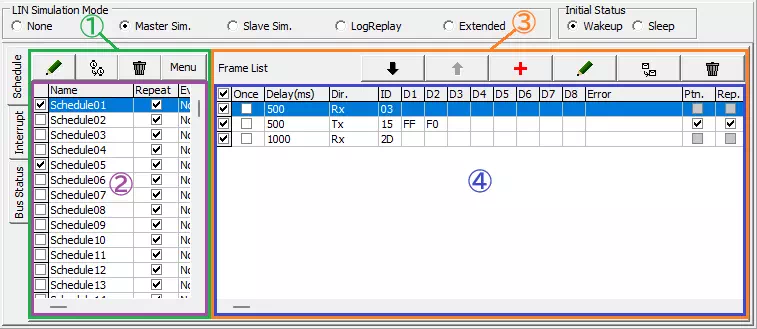
Schedule Tab
| Item | Description | Notes | |
|---|---|---|---|
| Schedule setting area (Area 1) | Schedule List (Area 2) | Displays configured schedule information. | See Schedule List. |
 button button | Opens LIN Schedule Setting dialog and edits schedule selected in Schedule List. | Double-clicking a schedule row in Schedule List (excluding checkbox cell) opens the same dialog. | |
 button button | Opens Copy Schedule Table dialog and copies frame information registered in selected schedule to another schedule (schedule information itself is not copied). | All frame information in destination schedule is deleted. | |
 button button | Shows delete dialog and deletes selected schedule information in Schedule List (all frame information is also deleted). | ||
 button button | Shows the following menu when clicked.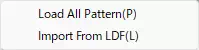 Selecting Load All Pattern loads in bulk the pattern files configured for frame information whose Ptn. check box is ON in Frame List across all schedules.Selecting Import From LDF imports in bulk the frame information of the schedule selected in Schedule List from the loaded LIN Description File (LDF). At that time, all frame information registered before the import is deleted. | ||
| Frame setting area (Area 3) | Frame List (Area 4) | Displays frame information registered in schedule selected in Schedule List. | See Frame List. |
 button button | Moves selected frame in Frame List down by one position. | You can also move frame position by dragging and dropping selected frame row in Frame List (excluding checkbox cell). | |
 button button | Moves selected frame in Frame List up by one position. | ||
| button | Opens Frame Setting dialog and registers a new frame. | ||
 button button | Opens Frame Setting dialog and edits selected frame in Frame List. | Double-clicking a frame row in Frame List (excluding checkbox cell) opens the same dialog. | |
 button button | Opens Frame Setting dialog and registers a new frame based on selected frame in Frame List. | ||
 button button | Shows confirmation dialog below. Click Yes to delete selected frame in Frame List.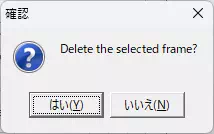 | ||
Schedule List
Displays configured schedule information. You can also set schedule enable/disable and whether schedule transmission repeats.
Double-clicking a schedule row (excluding checkbox cell) opens LIN Schedule Setting dialog, same as clicking .
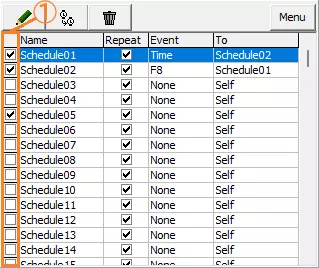
| Item | Description |
|---|---|
| Valid (Area 1) | Sets schedule enable/disable. ON = enabled, OFF = disabled. |
| Name | Displays schedule name. |
| Repeat | Sets whether schedule transmission repeats. ON: after transmitting the last frame in frame list, transmission returns to first frame and continues sequentially. OFF: transmission stops after transmitting the last frame. |
| Event | Displays trigger condition for schedule switch event. |
| To | Displays transition destination when schedule switch event occurs. |
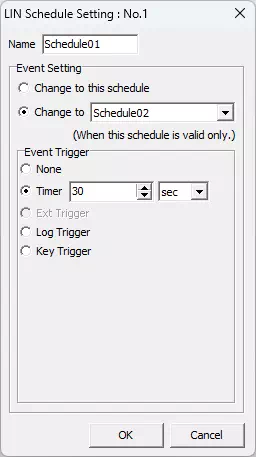
LIN Schedule Setting Dialog
| Item | Description |
|---|---|
| Name | Sets schedule name. Up to 14 characters. |
| Event Setting | Sets behavior when schedule switch event occurs. Options are:Change to this schedule: when schedule switch event occurs, transitions to this schedule.Change to ...: if this schedule is currently running and schedule switch event occurs, transitions to schedule specified in pull-down menu. |
| Event Trigger | Sets trigger condition for schedule switch event. See Event Trigger. |
Event Trigger
Sets trigger condition for schedule switch event.
| Item | Description |
|---|---|
| None | No schedule switch event occurs. |
| Time | Event occurs after configured time has elapsed since monitoring start or last schedule transition. Available ranges by unit: ms: 50-86400000 (multiples of 50 only)sec: 1-86400min: 1-1440hour: 1-24 |
| Ext Trigger | Event occurs by external port input. This function is under development and unavailable. |
| Log Trigger | Event occurs when configured log is detected. |
| Key Trigger | Event occurs on configured key input. Configurable keys: Main key: A-Z, 0-9, F1-F12, SPACE Sub key: Alt, Ctrl, Shift |
Copy Schedule Table Dialog
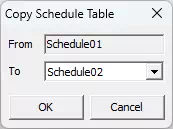
Copies frame information registered in selected schedule to another schedule in bulk (schedule name and event settings are not copied).
| Item | Description |
|---|---|
| Copy From | Select source schedule. |
| Copy To | Select destination schedule. |
| OK | Executes copy with current settings. |
| Cancel | Closes dialog (copy is not executed). |
Frame List
Displays the frame information registered in the schedule selected in Schedule List. You can also configure whether frame transmission is enabled, whether pattern data is repeated, and related settings.
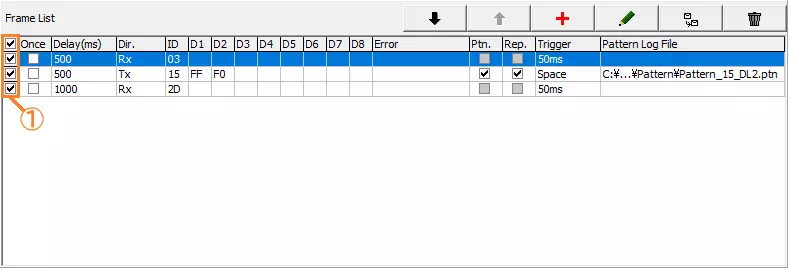
| Item | Description |
|---|---|
| Valid (Area 1) | Sets whether frame is transmitted. If OFF, that frame is not transmitted. |
| Once | Sets whether frame is transmitted repeatedly. If ON, that frame is transmitted only once during monitoring (not retransmitted until monitoring is stopped). |
| Delay | Displays transmission interval from previous frame. |
| Dir. | Displays frame type. |
| ID | Displays frame LIN ID in hexadecimal. |
| D1-D8 | If frame type is Tx, displays per-byte frame data in hexadecimal. |
| Error | Displays frame error type. |
| Ptn. | Sets whether to use a pattern file for the per-byte data of the frame. The meanings of the ON/OFF check box state are as follows.ON: Uses Pattern Setting in the Frame Setting dialog.OFF: Uses Frame Setting in the Frame Setting dialog. |
| Rep. | Sets whether to apply the pattern data list repeatedly.ON: When a pattern change event occurs after reaching the bottom of the pattern data list, processing returns to the top.OFF: Once the bottom of the pattern data list is reached, pattern change events remain disabled until monitoring stops. |
| Trigger | Displays the occurrence condition of the pattern change event. |
| Pattern Log File | Displays the file name of the pattern file to load. |
Frame Setting Dialog
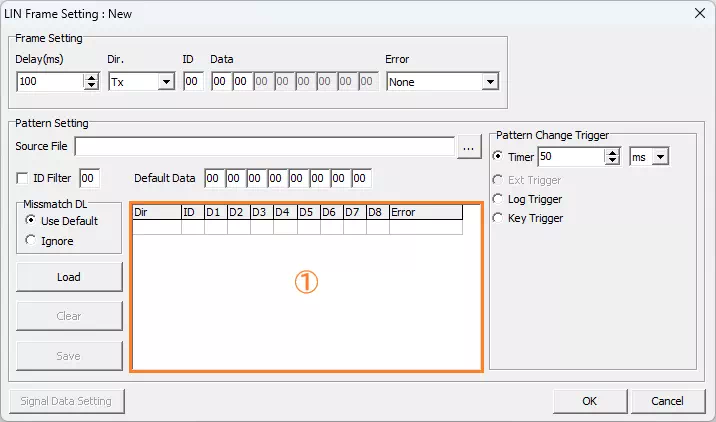
| Item | Description | Notes | |
|---|---|---|---|
| Frame Setting | Delay | Sets transmission interval from previous frame in milliseconds. Range: 1-3600000. | |
| Dir | Sets frame type. Pull-down options:Tx: transmit both header and response.Rx: transmit header only.Wakeup: transmit wakeup signal.Sleep: transmit sleep command. | ||
| ID | Sets frame LIN ID in hexadecimal. Range: 00H-3FH. | If out-of-range value (40H or higher) is set, value is automatically corrected to value right-shifted by 8 bits. Example: 57H is corrected to 05H.If Dir. is Wakeup or Sleep, this field is hidden. | |
| Data | Sets response data per byte in hexadecimal. | Hidden when Dir. is not Tx. | |
| Error | Sets error enable/type for frame. Options depend on Dir:Tx: None, SyncBrk. Long, SyncBrk. Short, SyncField Err., Parity Err., Checksum, ShortMsg. (1Byte)...ShortMsg. (8Byte), Framing(Data1)...Framing(Data8), Framing(CS)Rx: None, SyncBrk. Long, SyncBrk. Short, SyncField Err., Parity Err. | Hidden when Dir. is Wakeup or Sleep. | |
| Pattern Setting | Source File | Displays full path of pattern file selected via file dialog from  button. button. | You can also set pattern file by direct full-path input. |
| button | Opens file dialog and selects pattern file to load. | Selected file is not loaded until  button is clicked. button is clicked. | |
| ID Filter | Sets whether to filter pattern data contained in loaded pattern file. If ON, pattern data that matches none of the following is treated as invalid and not displayed in pattern data list: - ID equals value in ID Filter (value set in dialog ID)- Type is Wakeup- Type is Sleep | ||
| Default Data | Sets default data (hex) used when data length in loaded pattern data does not match ID definition in ID Definition tab of Device Setting. | ||
| Missmatch DL | Sets behavior when data length in loaded pattern data does not match ID definition in ID Definition tab of Device Setting. Options:Use Default: if ID-definition length is larger than pattern data length, default data fills missing bytes.Ignore: that pattern data is treated as invalid and not shown in pattern data list. | Example for Use Default:ID definition length: 4 bytes Pattern data: 08,4C (2 bytes) Default data: 11,22,33,44,55,66,77,88 In this case, bytes 3 and 4 use default data, so pattern data becomes 08,4C,33,44. | |
| button | Loads pattern file shown in Source File and displays its pattern data in pattern data list. | ||
 button button | Clears all pattern data shown in pattern data list. | ||
 button button | Opens file dialog and saves pattern data shown in pattern data list as a pattern file with any file name. | ||
| Pattern data list (Area 1) | Displays pattern data contained in loaded pattern file. | ||
| Pattern Change Trigger | Sets trigger condition for pattern change events. | See Pattern Change Trigger. | |
| button | Saves configured frame information and closes dialog. | ||
 button button | Discards configured frame information and closes dialog. | ||
Dialog title bar changes depending on operation used to open it.
| Operation | Title |
|---|---|
| Click |  |
| Click |  |
| Click |  |
Pattern Change Trigger
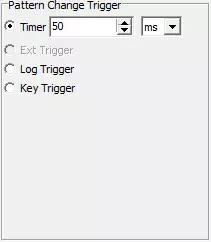
Sets trigger condition for pattern change events.
| Item | Description |
|---|---|
| Timer | Event occurs each time configured interval elapses. |
| Ext Trigger | Event occurs by external port input. Currently under development and unavailable. |
| Log Trigger | Event occurs when configured log is detected. |
| Key Trigger | Event occurs on configured key input. |
Timer
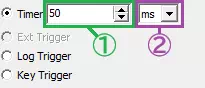
| UI Item | Description | Notes |
|---|---|---|
| Time value (Area 1) | Together with unit, sets cycle for pattern change event. Ranges by unit: ms: 50-3600000 (multiples of 50 only)sec: 1-3600min: 1-60 | With spin button, only when unit is ms, value changes in 50 ms steps. |
| Time unit (Area 2) | Together with time value, sets cycle for pattern change event. Options:ms, sec, min |
Log Trigger
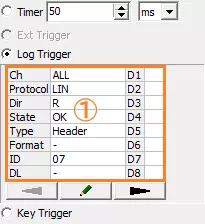
| UI Item | Description |
|---|---|
| Event condition (Area 1) | Displays log information configured as event trigger condition. Double-clicking this area opens Trigger Setting dialog to configure condition log information. |
 button button | Opens Trigger Setting dialog to configure condition log information. |
For details of the Trigger Setting dialog, see Trigger Setting dialog description.
Key Trigger
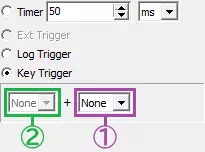
| UI Item | Description | Notes |
|---|---|---|
| Main key (Area 1) | Sets key used as event condition. Options:None, A-Z, 0-9, F1-F12, SPACE | If None is set, key-input event does not occur. |
| Sub key (Area 2) | Sets sub key combined with main key. Options:None, Alt, Ctrl, ShiftSet None when no sub key is used. | Sub-key-only event detection is not supported. |
Interrupt Tab
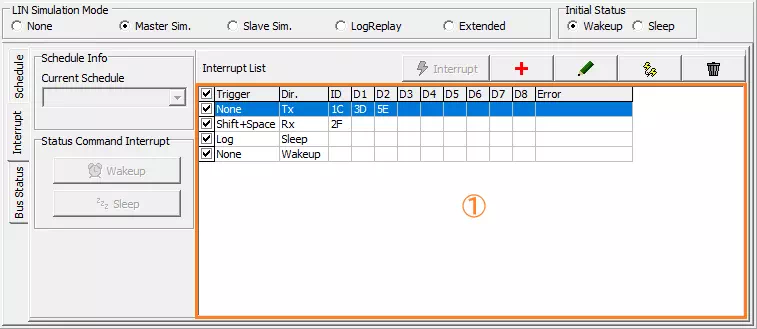
| UI Item | Description | |
|---|---|---|
| Schedule Info | Current Schedule | Displays currently running schedule. If a schedule is selected from pull-down options, after one full cycle of frames in current schedule is transmitted, transition occurs to selected schedule. |
| Status Command Interrupt |  button button | Transmits wakeup signal when clicked. If system is in sleep mode, wakeup signal cannot be transmitted by this button. |
 button button | Transmits sleep command and enters sleep mode when clicked. If Not Sleep by Sleep Command(3C) checkbox in Bus Status tab is ON, sleep mode transition does not occur even when sleep command is transmitted. | |
| Interrupt List | Interrupt Frame List (Area 1) | Displays configured interrupt-frame information. See Interrupt List. |
 button button | Transmits interrupt frame selected in Interrupt List. | |
 button button | Opens Interrupt Setting dialog and registers new interrupt frame. | |
 button button | Opens Interrupt Setting dialog and edits selected interrupt frame in Interrupt List. Double-clicking an interrupt-frame row in Interrupt List (excluding checkbox cell) opens same dialog. | |
 button button | Opens Interrupt Setting dialog and registers a new interrupt frame based on selected one in Interrupt List. | |
 button button | Shows confirmation dialog below.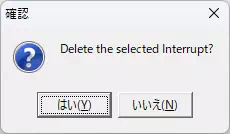 Click Yes to delete selected frame in Interrupt List. | |
Interrupt List
Displays registered interrupt-frame information. You can also set frame transmission enable/disable.
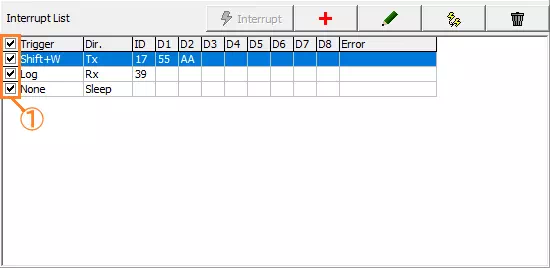
| Item | Description |
|---|---|
| Valid (Area 1) | Sets whether interrupt frame can be transmitted. If checkbox is OFF, frame is not transmitted. |
| Trigger | Displays trigger condition of interrupt-frame transmission event. |
| Dir. | Displays interrupt-frame type. |
| ID | Displays interrupt-frame LIN ID in hexadecimal. |
| D1-D8 | If interrupt-frame type is Tx, displays per-byte frame data in hexadecimal. |
| Error | Displays frame error type. |
Interrupt Setting Dialog
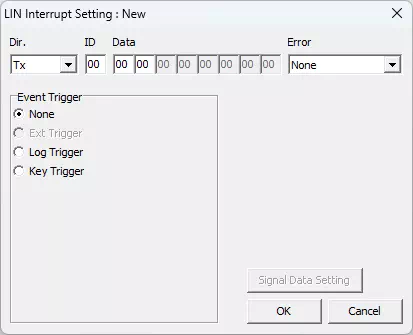
| Item | Description | Notes |
|---|---|---|
| Dir | Sets frame type. Options:Tx: transmit header and response.Rx: transmit header only.Wakeup: transmit wakeup signal.Sleep: transmit sleep command. | |
| ID | Sets frame LIN ID in hexadecimal. Range: 00H-3FH. | If out-of-range value is set,  button becomes disabled. button becomes disabled.If Dir. is Wakeup or Sleep, this field is hidden. |
| Data | Sets response data per byte in hexadecimal. | Hidden when Dir. is not Tx. |
| Error | Sets frame error enable/type. Options depend on Dir:Tx: None, SyncBrk. Long, SyncBrk. Short, SyncField Err., Parity Err., Checksum, ShortMsg. (1Byte)...ShortMsg. (8Byte), Framing(Data1)...Framing(Data8), Framing(CS)Rx: None, SyncBrk. Long, SyncBrk. Short, SyncField Err., Parity Err. | Hidden when Dir. is Wakeup or Sleep. |
| Event Trigger | Sets trigger condition for interrupt-frame transmission event. | See Event Trigger. |
| button | Saves configured interrupt-frame information and closes dialog. | |
 button button | Discards configured interrupt-frame information and closes dialog. |
Dialog title bar changes depending on operation used to open it.
| Operation | Title |
|---|---|
| Click button |  |
| Click button |  |
| Click button |  |
Event Trigger
Sets trigger condition for interrupt-frame transmission event.
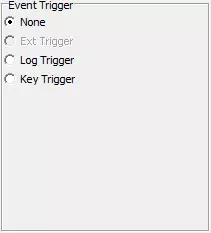
| Item | Description |
|---|---|
| None | No event occurs. |
| Ext Trigger | Event occurs by external port input. Currently under development and unavailable. |
| Log Trigger | Event occurs when configured log is detected. |
| Key Trigger | Event occurs on configured key input. |
Regardless of Event Trigger settings, interrupt frame can be transmitted by clicking button.
Log Trigger
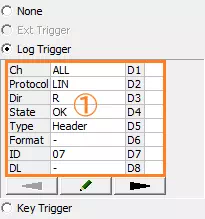
| UI Item | Description |
|---|---|
| Event condition (Area 1) | Displays log information configured as interrupt-frame event trigger condition. Double-clicking this area opens Trigger Setting dialog to configure condition log information. |
 button button | Opens Trigger Setting dialog to configure condition log information. |
For details of the Trigger Setting dialog, see Trigger Setting dialog description.
Key Trigger
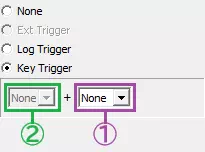
| UI Item | Description | Notes |
|---|---|---|
| Main key (Area 1) | Sets key used as event condition. Options:None, A-Z, 0-9, F1-F12, SPACE | If None is set, key-input event does not occur. |
| Sub key (Area 2) | Sets sub key combined with main key as event condition. Options:None, Alt, Ctrl, ShiftIf sub key is not used, set None. | Sub-key-only event detection is not supported. |
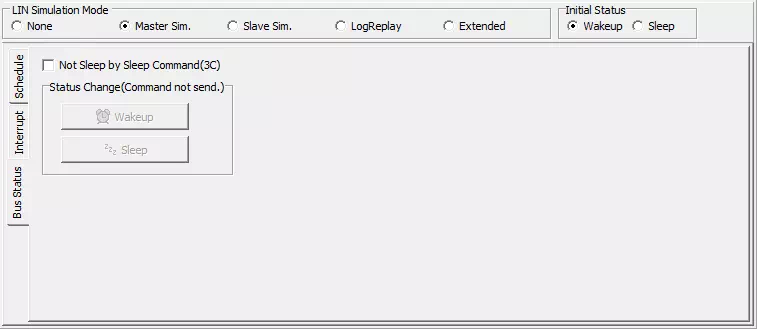
Bus Status Tab
| UI Item | Description | |
|---|---|---|
| Not Sleep by Sleep Command(3C) | Sets whether transition to sleep mode occurs when sleep command is transmitted/received.ON: does not transition to sleep mode even if sleep command is transmitted/received.OFF: transitions to sleep mode when sleep command is transmitted/received. | |
| Status Command Interrupt |  button button | Returns from sleep mode when clicked. Wakeup signal is not transmitted. |
 button button | Transitions to sleep mode when clicked. Sleep command is not transmitted. | |