Log File Specification
Communication log CSV stores original frames. Signal analysis CSV outputs signal values and is not a compatible log format. For reanalysis, keep communication logs together with the LDF/MPXSIG used during capture. To use the capture-time definitions with saved logs, select Load in the analysis Catalog, load MPXSIG, and select the Set to use. Saved log analysis and Log Replay on a real bus serve different purposes.
Log Files
MicroPeckerX LIN Analyzer Plus outputs captured logs to CSV log files.
The contents of log files are described below.
Sample Log File
Figure 1 shows LN1SpeedTrigger_1-1.csv automatically saved from monitoring started at 2026/11/08 19:40:44. Ch is 1-1 and Offset is +0000000.000000.

Figure 1: Header and data of a saved communication log CSV.
This CSV contains three Header rows and three Response rows from the recording interval in the 20–40 second range. Single View and Dual View in Monitor Window show all eight rows from the same monitoring session, so the displayed and saved row counts differ. The file was saved in the 002 folder under Log Folder.
Each Response has Ch 1-1, Protocol LIN, Dir T, Label SensorFrame, State OK, ID 10 (hexadecimal 0x10), and DL 2. Compare Time, D1, D2, and D9 with the table below. CSV D9 corresponds to CS in Monitor Window and Each ID Window.
| Time | D1/D2 | D9 (checksum) |
|---|---|---|
| +0000020.002580 | 22 01 | DC |
| +0000030.002580 | 1C 01 | E2 |
| +0000040.002580 | 18 01 | E6 |
Header Section
Outputs an overview of the log file.
The output columns are as follows.
| Item | Description | Additional information |
|---|---|---|
| FileName | Displays the file name at output. | |
| DateTime | Displays the monitoring start date/time in YYYY/MM/DD hh:mm:ss format. | Logs saved from the Analyze tab in Analyze Window show the date/time when logs were merged. |
| Ch | Displays the logging channel number (for example, 1-1). | Shows Mixed when saving logs merged from multiple channels in the Analyze tab in Analyze Window. |
| Offset | For a log saved with timestamp offset display enabled in Analyze Window, displays the reference log timestamp. Shows zero when offset display is disabled. | Uses Time Stamp Form from the Option dialog used for CSV saving. |
Data Section
Outputs one monitored frame per data row.
The output columns are as follows.
| Item | Description | Additional information |
|---|---|---|
| Time | Displays the transmission/reception timestamp. | Uses Time Stamp Form in the Option dialog used for CSV saving. |
| Ch | Displays the transmission/reception channel. | |
| Protocol | Displays the transmission/reception protocol. | |
| Dir | Shows T for transmitted frames and R for received frames. | Shows - (hyphen) when Type is B-Sleep (no frame transmission/reception). |
| Label | Displays the label name of the first matching enabled condition, evaluated from the top of Label Filter when saving the CSV. | See Labels. |
| State | Shows OK for valid frames and NG for error frames. | |
| Type | Displays one of the following frame types. [Valid frames] Header, Response, LIN Frm, Wakeup, Sleep, B-Sleep [Error frames] Parity Err., CheckSum Err. ShortMsg Err., Bit Err., NoRes Err., SyncBrk. Long, SyncBrk. Short, SyncField Err, Framing Err., H. Timeout, UART Err., Bus Err. | |
| Format | Displays the break field bit width or wake-up signal transmission/reception duration for the following Type values. [Break field bit width] Header, LIN Frm., Sleep, SyncBrk. Short, Parity Err., SyncField Err. [Wake-up signal transmission/reception duration] Wakeup | Shows - (hyphen) for Type values not listed here. |
| ID | Displays the transmitted/received ID in hexadecimal. | |
| DL | Displays the transmitted/received data length. | |
| D1~D8 | Displays transmitted/received data in hexadecimal. | Shows - (hyphen) if a framing error occurs. |
| D9 | Displays the transmitted/received checksum. | Shows - (hyphen) if a framing error occurs. |
Destination Folders and File Names
Automatically Saved Log Files
With Save Log File on, data from recording intervals is saved automatically after monitoring stops.
When saving CSV after stopping, the application selects the smallest unused three-digit sequence number (000–999) directly under Log Folder and saves into a subfolder with that number. If all numbers are in use, an error appears during CSV saving. Change Log Folder before the next recording.
The basic file name format is Log File Name_Ch number.csv. For example, if Log File Name is Capture and the channel number is 1-1, the file is Capture_1-1.csv. The number of recording intervals and file splitting settings change the names as follows.
| Recording intervals | Splitting | Example file names |
|---|---|---|
| One interval | Disabled | Capture_1-1.csv |
| One interval | Enabled | Capture_1-1_0000.csv, Capture_1-1_0001.csv, … |
| Multiple intervals | Enabled or disabled | Capture_1-1_0000.csv, Capture_1-1_0001.csv, … for successive intervals. If a later interval has no log records for the target channel, a file may not be created for that interval. |
Splitting by time, file size, or record count applies when there is one recording interval.
Manually Saved Log Files
Use the save button in Analyze or Ch Log in Analyze Window to save the displayed communication log manually. Figure 2 shows the Ch Log controls; click the floppy disk button outlined in red. This is a separate operation from automatic saving in Figure 1.
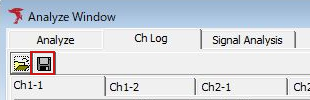
Figure 2: Ch Log save controls.
The destination and file name for manual saving are as follows.
| Item | Description | Additional information |
|---|---|---|
| Destination folder | Folder path specified in the file dialog | |
| Log file name | File name specified in the file dialog | The default log file name is: "Ch" + "channel number (1-1, 1-2, ..., 4-2)" + "_ (underscore)" + "monitoring start or log merge date/time (YYYYMMDDhhmmss)" + "extension (.csv)" |