Option Settings
The Option dialog lets you fine-tune behavior related to monitoring, log display, logging, and other functions.
When checking LIN signal values against source data, also check LIN/CXPI Log Type in Log Option. With Header + Response, header rows alone do not show response data. Configure signal definitions and CH assignments in Signal Catalog.
Configuring Options
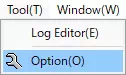
- Open the Option dialog
Select Tool → Option from the menu bar, or click the toolbar button, to open the Option dialog.
- Change option settings
Change the desired settings in the Option dialog. Click OK to apply the changes.
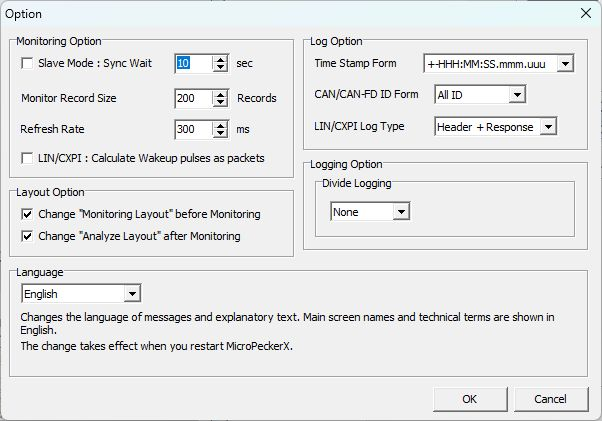
Option Dialog
| Item | Description | Notes | |
|---|---|---|---|
| Language | Select English or Japanese for messages and explanatory text. | English is used if no language has been set. The change takes effect after restarting MicroPeckerX. See Changing the Display Language. | |
| Monitoring Option | Slave Mode | Enables or disables slave mode. When checked, the application operates as a time synchronization slave. While waiting for synchronization, it automatically starts and stops monitoring in response to the time synchronization master (stopping has a timing error of approximately several tens of milliseconds). | Use slave mode when this application should act as a time synchronization slave, for example when synchronizing MicroPeckerX with MicroPecker, or multiple MicroPeckerX units across two PCs. |
| Sync Wait | When slave mode is enabled, specifies the maximum wait for a synchronization signal from the time synchronization master after the slave enters the synchronization wait state, in seconds. The range is 1–60. | If no synchronization signal from the master is received within the Sync Wait period after the slave enters the synchronization wait state, a “Monitor synchronization error.” occurs and the wait state is canceled. | |
| Monitor Record Size | Sets the maximum number of log records retained and displayed in Monitor Window. The range is 100–100,000 records. | The spin buttons increase or decrease the value in steps of 100 records. | |
| Refresh Rate | Sets the redraw interval (display update timing) for each GUI application window, in milliseconds. The range is 100–1000. | The spin buttons increase or decrease the value in steps of 100 milliseconds. | |
| LIN/CXPI : Calculate Wakeup pulses as packets | For LIN or CXPI communication, specifies whether wake-up signals are included in the packet count shown in Monitor Window Status. The checkbox states have the following meanings: [ON] Includes wake-up signals in the packet count. [OFF] Excludes wake-up signals from the packet count. | Changing this setting does not update the Status display after monitoring has stopped. | |
| Layout Option | Change "Monitoring Layout" before Monitoring | Specifies whether the screen layout changes automatically when monitoring starts. The checkbox states have the following meanings: [ON] Changes to Monitoring Layout when monitoring starts. [OFF] Does not change the layout when monitoring starts. | |
| Change "Analyze Layout" before Monitoring | Specifies whether the screen layout changes automatically when monitoring stops. The checkbox states have the following meanings: [ON] Changes to Analyze Layout when monitoring stops. [OFF] Does not change the layout when monitoring stops. | ||
| Log Option | Time Stamp Form | Sets the timestamp display format for log records. The drop-down options are as follows: +-HHH:MM:SS.mmm.uuu, +-SSSSSSS.mmmuuu | This setting also applies when saving log files. If a log file saved with a different setting is loaded, its timestamp display format is automatically converted to the current setting. |
| CAN/CAN-FD ID Form | Sets the ID display format for extended-format CAN frames. The drop-down options and their meanings are as follows: [ALL ID] Displays the standard ID (SID) and extended ID (EID) as one continuous 29-bit value. The upper 11 bits are the standard ID and the lower 18 bits are the extended ID. [SID/EID] Displays the standard ID (SID) and extended ID (EID) separately. The standard ID is on the left and the extended ID on the right. | This setting also applies when saving log files. If a log file saved with a different setting is loaded, its ID display format is automatically converted to the current setting. | |
| LIN/CXPI Log Type | Sets the display format of LIN or CXPI logs in Monitor Window, Each ID Window, and Analyze Window. The drop-down options and their meanings are as follows: [Header + Response] Displays the header and response separately. The log Type is Header for the header and Response for the response. [LIN/CXPI Frame] Displays the header and response together. The log Type is LIN Frame or CXPI Frame. | This setting also applies when saving log files. However, loading a log file saved with a different setting does not convert its display format. Changing this setting also does not update the format of logs already displayed in each window. | |
| Logging Option | Divide Logging | Specifies whether to split log files automatically under certain conditions when saving. The drop-down options and their meanings are as follows: [None] Does not split files automatically. [FileSize] Automatically splits a log file when its size reaches the threshold. The threshold range is 1–4095 megabytes. [Record] Automatically splits a log file when its number of saved records reaches the threshold. The threshold range is 100–2500000. [Time] Automatically splits a log file when the elapsed time since saving started reaches the threshold. The threshold range is 1–3600 seconds. | This setting applies only to log files saved automatically during monitoring. |
Changing the Display Language
If no language has been set, the application uses English. This setting changes messages and explanatory text in MPXAnalyzer and the standard plug-ins. Main screen names and technical terms are shown in English.
- Select
Tool→Option. - Under
Language, selectEnglishorJapanese, then clickOK. - To apply the change now, click
Restart now(Japanese:今すぐ再起動). To continue in the current language, clickLater(Japanese:後で). The saved language takes effect the next time you start MicroPeckerX.
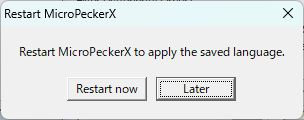
Restart confirmation after selecting English.
The confirmation uses the selected language. If an operation is running and prevents a restart, finish it, reopen Option, and click OK to confirm the restart again. If automatic restart fails, exit MicroPeckerX and open it again. See Language Setting Messages for troubleshooting.
See Changes in Ver.4.10 for other changes in this version.