Batch Log Record Editing
Batch add/delete multiple log records.
For log records with protocol DIO or A/D, only deletion is possible (addition is not available).
Basic Operations
Batch Add Multiple Log Records
- Click the Generate tab.
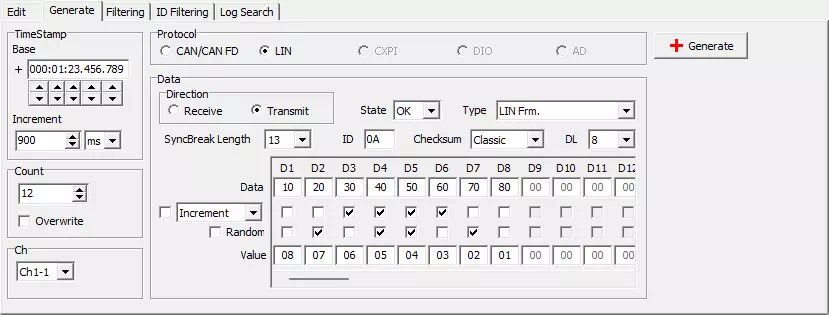
- Set each item in the Generate tab (timestamp, count, protocol, data, etc.) as needed.
See here for details. - Click the
 button in the Generate tab. Log records are added based on Generate tab settings.
 - To add more records, repeat steps 2 and 3.
If a log record with the same timestamp and Ch already exists in the log display area when step 3 is executed, the error dialog The log of the same time and Ch cannot be added. appears and the records cannot be added.
Batch Delete Log Records in a Specific Range
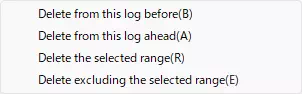
Right-clicking the log display area shows the following menu. You can delete log records in specific ranges in batch.
| Menu | Description |
|---|---|
| Delete from this log before | Deletes all log records above the selected log record in the log display area. |
| Delete from this log ahead | Deletes all log records below the selected log record in the log display area. |
| Delete the selected range | Deletes all log records in the selected range in the log display area. |
| Delete excluding the selected range | Deletes all log records except for the selected range in the log display area. |
To select a range of multiple log records, select the starting log record, then hold the Shift key and select the ending log record.
Generate Tab Screen Description
| Item Name | Description | |
|---|---|---|
| TimeStamp | Base | Specifies the first timestamp of the log records to add. Can be changed by direct input or spin buttons. |
| Increment | Specifies the timestamp increment value added sequentially from Base for the 2nd and subsequent records. Numeric value can be changed by direct input or spin buttons, and unit (s/ms/us) can be changed by pull-down. | |
| Count | Count | Specifies the number of records to add. Can be changed by direct input or spin buttons. |
| Overwrite | When checked, if records to add have the same timestamp and target Ch as existing records in the log display area, those existing records are overwritten. | |
| Ch | Selects the target channel (Ch) of log records from pull-down. | |
| Protocol | Selects the log record protocol with radio buttons. | |
| Data | Specifies log record data and related values. Displayed items differ by selected protocol. See CAN/CAN FD and LIN. | |
| button | Adds the number of records specified by Count to the log display area based on Generate tab settings. | |
If Overwrite is unchecked and some records to add overlap with existing records in timestamp and target Ch, clicking shows the error dialog The log of the same time and Ch cannot be added. and no records are added.
Details of Data Fields
CAN/CAN FD
| Item Name | Description | Display Condition |
|---|---|---|
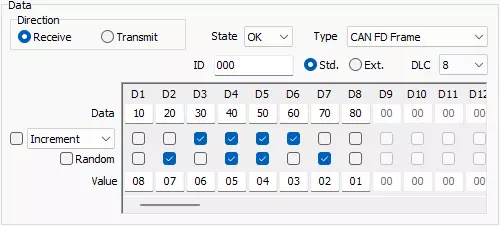
| Direction | Select frame direction (Tx/Rx) with radio buttons. | Always |
| State | Select frame state (OK/NG) from pull-down. | Always |
| Type | Select frame type from pull-down. Choices by State: OK: CAN FD Frame, CAN FD (no BRS) Frame, CAN Data Frame, CAN Remote Frame NG: Bus Err., Err. Warning, Err. Passive, BusOff, BO Recovery, OverLoad, BusLock, Arb. Lost, Stuff Err., Form Err., Ack Err., CRC Err., RBit Err., DBit Err., AckDel Err. | Always |
| ID | Specify frame ID in hexadecimal. | State = OK |
| Std./Ext. | Select frame ID format with radio buttons. | State = OK |
| DLC | Select frame data length from pull-down. Choices: 0, 1, 2, 3, 4, 5, 6, 7, 8, 12, 16, 20, 24, 32, 48, 64 | State = OK |
| Data | Specify byte data of the frame in hexadecimal. | State = OK and Type is one of: CAN FD Frame, CAN FD (no BRS) Frame, CAN Data Frame |
| Increment/Decrement | Specifies increase/decrease settings for each byte of frame data. Increase/decrease type is selected by pull-down; enable/disable by checkbox. | State = OK and Type is one of: CAN FD Frame, CAN FD (no BRS) Frame, CAN Data Frame |
| Random | Select enable/disable of random setting for each byte of frame data by checkbox. | State = OK and Type is one of: CAN FD Frame, CAN FD (no BRS) Frame, CAN Data Frame |
| Value | Specify byte data settings for increase/decrease or random behavior in hexadecimal. Meaning differs by Increment/Decrement and Random settings. See here. | State = OK and Type is one of: CAN FD Frame, CAN FD (no BRS) Frame, CAN Data Frame |
If Inc.(Range) or Dec.(Range) is selected in Increment/Decrement pull-down, Random cannot be enabled.
LIN
| Item Name | Description | Display Condition |
|---|---|---|
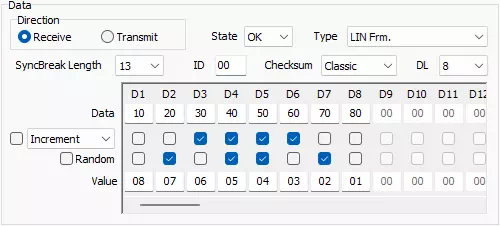
| Direction | Select frame direction (Tx/Rx) with radio buttons. | Type is not B-Sleep |
| State | Select frame state (OK/NG) from pull-down. | Always |
| Type | Select frame type from pull-down. Choices by State: OK: Header, Response, LIN Frm., Wakeup, Sleep, B-Sleep NG: SyncBrk. Long, SyncBrk. Short, Parity Err., ShortMsg Err., Checksum Err., NoRes. Err., Bit Err., Framing Err., SyncField Err., H. Timeout, UART Err., Bus Err. | Always |
| SyncBreak Length | Select SyncBreak length from pull-down. | Type is one of: Header, LIN Frm., Sleep, SyncBrk. Short, Parity Err., SyncField Err. |
| Wakeup Width | Specify wakeup pulse width (us). | Type = Wakeup |
| ID | Specify frame ID in hexadecimal. | Type is one of: Header, Response, LIN Frm., Parity Err., ShortMsg. Err., Checksum Err., NoRes. Err., Framing Err., SyncField Err. |
| Checksum | Select checksum format (Classic/Enhanced) from pull-down. | Type is one of: Response, LIN Frm., Checksum Err. |
| DL | Select data length from pull-down. Choices: 1, 2, 3, 4, 5, 6, 7, 8 | Type is one of: Response, LIN Frm., ShortMsg. Err., Checksum Err., Framing Err. |
| Data | Specify byte data of the frame in hexadecimal. | Type is one of: Response, LIN Frm., ShortMsg. Err., Checksum Err., Framing Err. |
| Increment/Decrement | Specifies increase/decrease settings for each byte of frame data. Increase/decrease type is selected by pull-down; enable/disable by checkbox. | Type is one of: Response, LIN Frm., ShortMsg. Err., Checksum Err., Framing Err. |
| Random | Select enable/disable of random setting for each byte of frame data by checkbox. | Type is one of: Response, LIN Frm., ShortMsg. Err., Checksum Err., Framing Err. |
| Value | Specify byte data settings for increase/decrease or random behavior in hexadecimal. Meaning differs by Increment/Decrement and Random settings. See here. | Type is one of: Response, LIN Frm., ShortMsg. Err., Checksum Err., Framing Err. |
If Inc.(Range) or Dec.(Range) is selected in Increment/Decrement pull-down, Random cannot be enabled.
Log Record Data by Increment/Decrement and Random Settings
When adding multiple log records, data values of each record behave as follows depending on Increment/Decrement and Random settings.
| Increment/Decrement | Random | Description |
|---|---|---|
| Disabled | Disabled | For all added records, data is exactly the value specified in Data. |
| Enabled / Increment | Disabled | First record uses Data as is. From second record onward, Value is added sequentially to the Data base value. Example: Data=10H, Value=05H -> 1st record 10H, then increments by 05H. |
| Enabled / Decrement | Disabled | First record uses Data as is. From second record onward, Value is subtracted sequentially from the Data base value. Example: Data=10H, Value=05H -> 1st record 10H, then decrements by 05H. |
| Enabled / Inc.(Range) | Disabled | First record uses Data as is. From second record onward, value increments by 01H from Data. When value reaches Value, next record returns to Data. Example: Data=15H, Value=25H -> increments by 01H until 25H, then returns to 15H. |
| Enabled / Dec.(Range) | Disabled | First record uses Data as is. From second record onward, value decrements by 01H from Data. When value reaches Value, next record returns to Data. Example: Data=25H, Value=15H -> decrements by 01H until 15H, then returns to 25H. |
| Disabled | Enabled | For all added records, data is randomly selected from the range between Data and Value. Example: Data=20H, Value=70H -> random values from 20H to 70H (same even if Data/Value are swapped). |
| Enabled / Increment | Enabled | First record uses Data as is. From second record onward, random value in range 0 to Value is sequentially added to the Data base value. Example: Data=10H, Value=05H -> 1st record 10H, then add random values in 00H-05H range. |
| Enabled / Decrement | Enabled | First record uses Data as is. From second record onward, random value in range 0 to Value is sequentially subtracted from the Data base value. Example: Data=10H, Value=05H -> 1st record 10H, then subtract random values in 00H-05H range. |